





Table of Contents
Challenges of Traditional Capsule Endoscopy
Capsule endoscopy (CE) is a minimally invasive imaging technique used to examine the gastrointestinal tract, particularly the small intestine. Its advantages include patient comfort and the ability to detect lesions that are difficult to diagnose using other methods.
However, the traditional data analysis process in CE comes with significant limitations:
- A single procedure generates between 50,000–70,000 images,
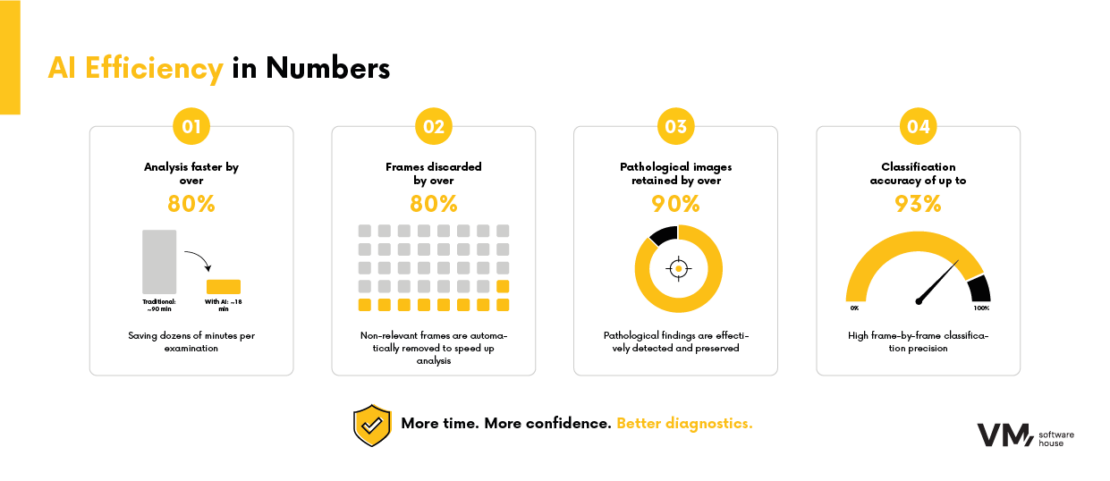
- The analysis takes approximately 90 minutes on average and requires the specialist’s full attention,
- Physician fatigue increases the risk of diagnostic errors and the omission of subtle abnormalities,
- Lack of standardization results in varied interpretations between specialists,
- A large portion of the images are non-diagnostic or normal, which slows down the process.
With rising demand for CE procedures and limited medical personnel, these barriers are becoming a serious systemic issue.
The Role of Artificial Intelligence in Improving Diagnostics
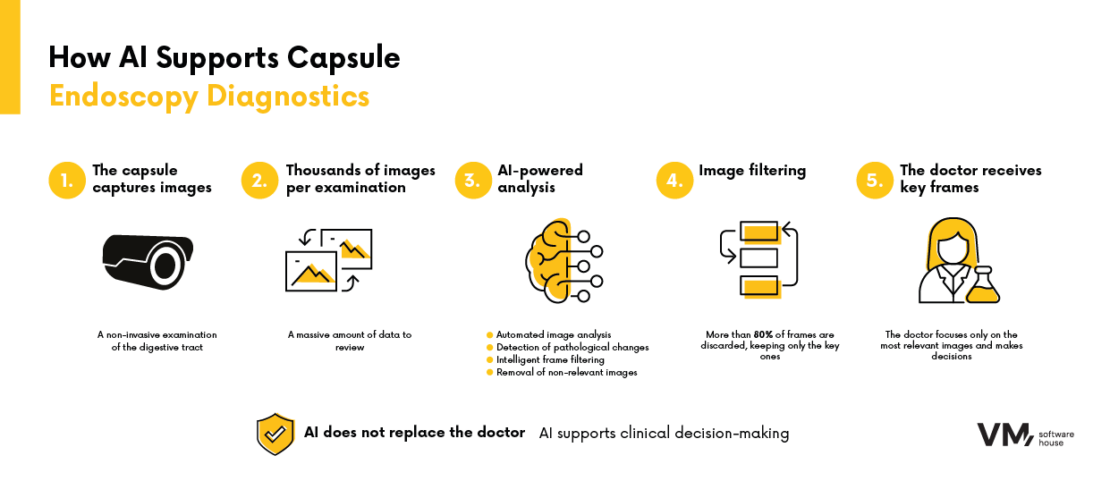
The solution to the above problems lies in the application of artificial intelligence. Convolutional neural network (CNN)-based models can automatically analyze vast volumes of images, identifying pathological changes and discarding frames without diagnostic value. This allows physicians to focus on the most critical parts of the exam instead of reviewing the entire dataset.
These algorithms are capable of detecting eleven classes of pathologies – from polyps and ulcers to bleeding and inflammation. Moreover, these systems not only highlight potential abnormalities but also assess bowel preparation quality, which is crucial for diagnostic accuracy. The most impactful feature, however, is intelligent image filtration: over 80% of frames are automatically discarded while retaining more than 90% of images containing pathologies.
This approach not only reduces analysis time by dozens of minutes but also increases diagnostic precision. The best models achieve an accuracy rate of around 93% in frame-by-frame classification, a result that is difficult to match even by highly experienced specialists.
Synthetic Data as a Breakthrough in Model Training
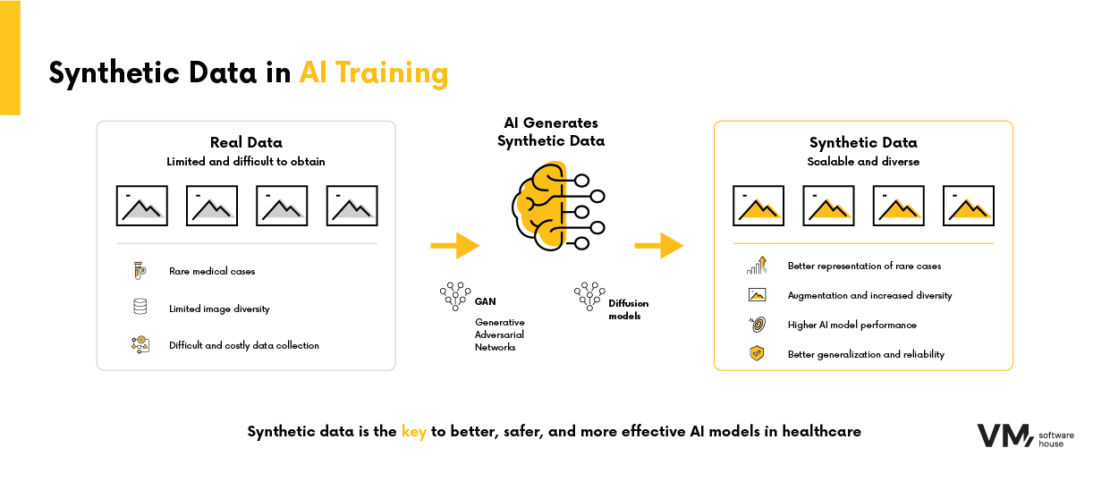
One of the key challenges in AI-driven medicine is the lack of sufficiently large and balanced datasets. In capsule endoscopy, this issue is particularly pronounced—some pathological changes are rare and appear too infrequently in datasets for models to learn them effectively.
The solution lies in using synthetic data. Traditional image augmentation techniques, such as morphological transformations or controlled noise addition—can increase data diversity and improve the representation of rare classes. However, even greater potential comes from generative models, such as GANs (Generative Adversarial Networks) or Diffusion Models. These can create fully realistic images of pathologies that are nearly indistinguishable from real endoscopic photos.
This enables algorithms to learn to recognize not only the most common abnormalities but also those that occur only sporadically in patients. Importantly, the credibility of these models is supported by explainable AI techniques. Methods like GradCAM allow visualization of the image regions that most influenced the algorithm’s decision. As a result, the physician receives not just the classification output but also a rationale for the decision, increasing trust in the system.
From Data to a Ready-to-Use Diagnostic Platform
An AI model alone is just the beginning. The key to success lies in its proper deployment in clinical practice.
- The process begins with building large datasets – comprising millions of capsule endoscopy images, hundreds of thousands of which must be carefully annotated by experts.
- Real-world data is then combined with synthetic data to create a balanced and comprehensive training set.
- The model is trained on this dataset using advanced self-supervised learning techniques and architectures designed to be robust to image rotations and capable of handling small sample sizes in rare classes.
- The next step is integrating the algorithm with existing diagnostic systems, typically through an API. The final platform provides physicians not only with analysis results but also interactive overlays, visualizations, and confidence metrics.
As a result, the analysis of a single exam takes over 80% less time. Instead of reviewing tens of thousands of frames, the physician only needs to examine a small, highly relevant portion of the material. This leads to increased clinical throughput, improved standardization of results, and reduced risk of errors.
Trends in the Use of AI in Gastroenterology
AI-powered solutions in gastroenterology are evolving at an exceptional pace. Just a few years ago, they were considered a novelty—today, they are becoming the standard in leading diagnostic centers. This trend is driven by the growing demand for fast and accurate diagnoses amid a shortage of medical specialists.
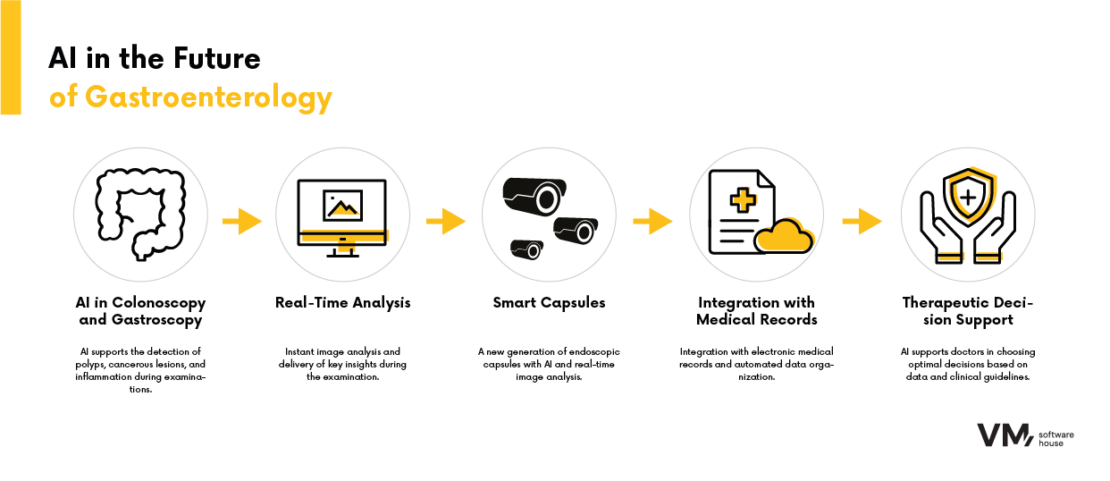
In the coming years, we can expect AI to be increasingly applied not only in capsule endoscopy but also in colonoscopy, gastroscopy, and the analysis of images from other diagnostic modalities such as CT (computed tomography) and MRI (magnetic resonance imaging). The direction is clear: automation of routine medical tasks and the delivery of tools that enhance efficiency and precision for physicians.
Regulatory Aspects and Data Security
Implementing artificial intelligence in medicine requires more than just advanced technology—it demands strict adherence to regulatory frameworks. AI models must comply with medical device regulations, and the processes involved in their training and validation must meet high ethical and quality standards.
Data security is also a critical concern. The images used to train AI models often contain sensitive medical information, meaning their processing must comply with GDPR and health data protection standards. Companies deploying AI in capsule endoscopy must therefore not only ensure the effectiveness of their algorithms but also guarantee full privacy protection for patients.
The Future of Capsule Endoscopy
Artificial intelligence marks just the beginning of the transformation in capsule endoscopy. In the future, we can expect the development of capsules equipped with additional sensors, motion control capabilities, and real-time data transmission. Combined with AI, this will pave the way for even more accurate and personalized diagnostics.
An especially important area of development will be the integration of diagnostic systems with electronic medical records and the creation of ecosystems where AI supports physicians at every stage—from patient preparation and image analysis to therapeutic decision-making.
If you’re interested in implementing artificial intelligence in capsule endoscopy or other diagnostic workflows in your organization—get in touch with us.
