





In the business world we increasingly say that technology – and especially artificial intelligence (AI) – is becoming a key element of competitive advantage. That’s why we decided to build our own solution – AI Chat – which not only gives customers modern ways to search and interact with content, but also positions the company as a partner, not just a service provider.
AI Chat is an example of a practical AI implementation in a company, showing how AI can genuinely support customer service and process automation. In this article we present our journey: from needs analysis, through prototyping and deployment, to development strategies and benefits for both the customer and the company.
Table of Contents
Why did we build AI Chat on VM.pl?
We chose innovation and a customer‑centric approach. Our objective was to provide users with modern technologies that enable rapid and intuitive content search, so that interaction with the site is dynamic, rather than limited to static subpages.
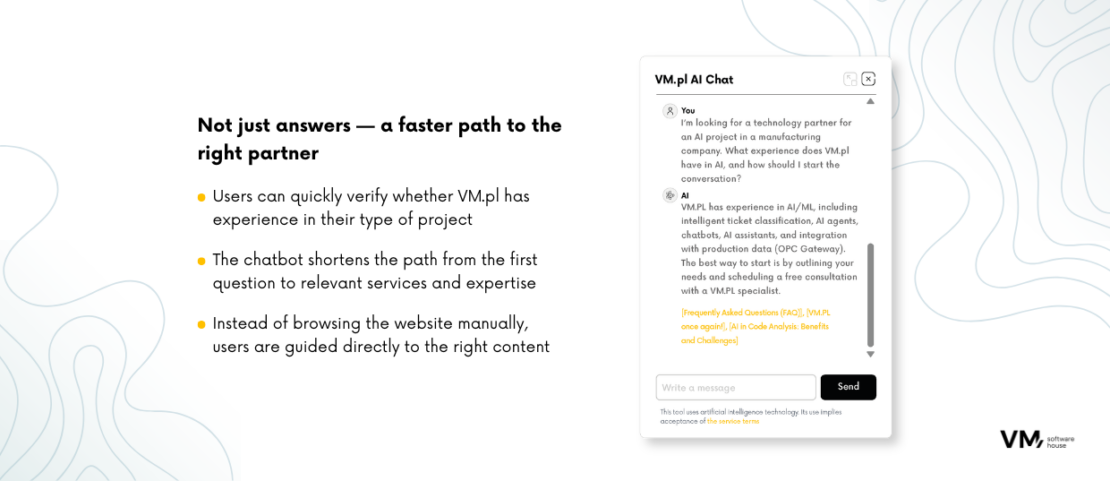
After analyzing available market solutions we concluded that creating our own chatbot would allow us to better tailor the technology to our site structure and content, effectively integrate it with communication channels – including LinkedIn – and maintain full control over quality and cost of operation. We also wanted the chatbot to deliver to users substantive, contextual answers based on real examples of our projects, utilized technologies and team competencies.
How Does Our AI Chat Work?
Integration with Website Content and Social Channels
When designing the solution, we wanted the chatbot to deliver not only information found on the VM.pl website but also content from our external channels such as LinkedIn, where we share case studies, articles, and team insights. This ensures users get contextually relevant answers, can easily access source materials, and gain a fuller picture of our work and competencies.
Why the Chatbot Starts with Specific Implementations
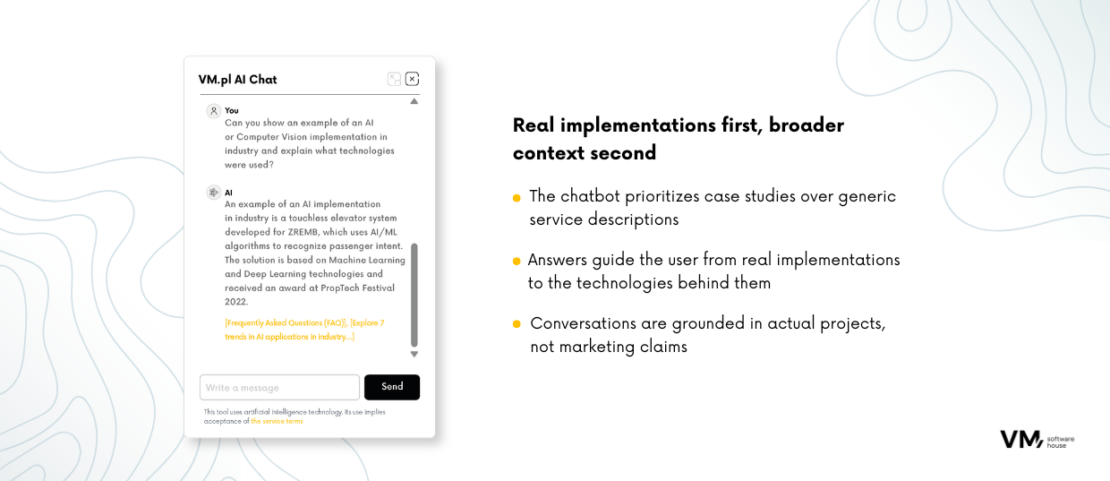
Before the chatbot searches the entire knowledge base, it first checks whether the user’s question relates to topics covered in our case studies. If so, it prioritizes those responses.
This brings tangible benefits:
- it highlights real implementations and the team’s results,
- it helps users understand processes and technologies through practical examples,
- it shortens the path to a sales conversation – acting as a pre-sales tool.
Only afterward does the chatbot pull from other knowledge sources – such as technology info, team bios, services, or processes.
How We Combine Data from Multiple Sources to Deliver Better Answers
Our chatbot is powered by diverse knowledge sources merged into a single system:
- Prompt data – Ideal for fixed content like company address, contact details, or owner name. Always available directly.
- Text files – Great for dynamic content like promotions, FAQs, or news.
- Vector databases (RAG) – Used to store rich, semi-static knowledge like case studies or technical documentation. This content is well-structured and easily searchable.
Thanks to this, the chatbot can instantly identify the most relevant source of truth and match it to the user’s intent – no chaos, no wandering, no repetition.
Step-by-Step Implementation Process
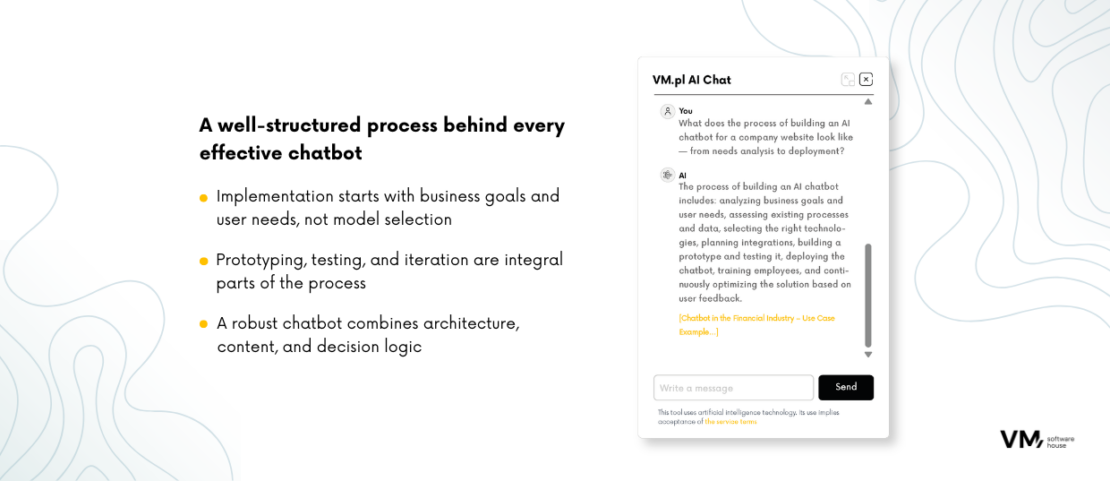
We applied the 4D Methodology framework to ensure the process was clear, structured, and focused on delivering client value.
Discovery
In this phase, we focused on:
- Defining project goals – what we wanted to achieve,
- Understanding users – who VM.pl’s clients are, what questions they ask, and which content they consume most,
- Assessing feasibility – considering our resources, technologies (WordPress, database), budget, and timeline.
Definition
After completing the analysis, we moved into design:
- Created a prototype architecture as a WordPress plugin,
- Identified technical requirements, including converting data into vector format and using cascading logic,
- Designed a simple, intuitive user interface,
- Allocated time for enhancements and testing – which proved critical to the final solution’s quality.
Delivery
This phase covered all the technical and testing activities needed to launch the chatbot.
- Implementation involved setting up the environment, integrating the database, and applying cascading model logic.
We deployed a smaller AI model for initial query analysis and a larger one for generating answers. - We introduced query length limits (up to 150 words) and filters for questions unrelated to our business, optimizing both cost and quality.
Our solution is based on OpenAI’s GPT‑4.1 and GPT‑4.1-mini models. The full business logic – including AI models, the vector database, and the Azure Function handling queries and responses – runs on Microsoft Azure’s stable infrastructure. This ensures high availability, security, and full scalability, making it easy to grow and deploy for clients.
Direction
- We review chatbot queries weekly to identify what users ask most and what we can improve.
- We plan to add an “FAQ” section to the site with popular chatbot questions – simplifying user access and reducing operational costs.
- We’re also considering a “mini model” for basic questions – a faster and cheaper alternative to the large AI model.
Security of the Chatbot – How Do We Effectively Protect Our Bot?
Securing a chatbot is a critical part of any AI implementation. There is no universal rulebook – each chatbot requires a tailored approach based on its function, industry, and target audience. A bot supporting external customers needs different filters than an internal assistant for IT staff.
3 Layers of Chatbot Security
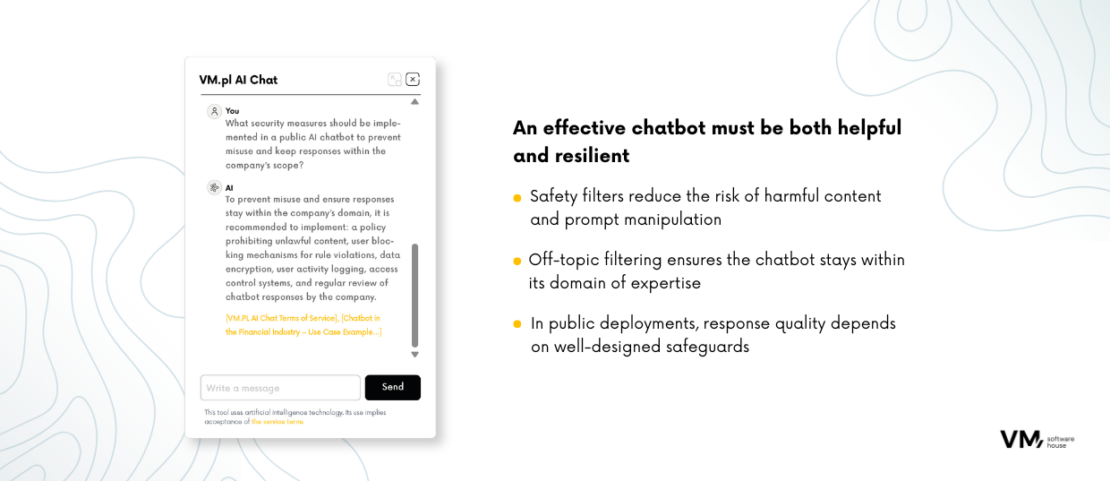
- Content Moderation with Azure AI Content Safety
We use Microsoft cloud tools that automatically detect and block:
- Hate speech,
- Violence,
- Sexual content,
- Self-harm.
The system also protects against so-called jailbreak attempts, where users try to manipulate the bot.
- Profanity and Custom Blocklists
We create tailored blocklists to filter out words inappropriate for a given organization. This ensures better alignment with the company’s culture, language, and industry norms.
- Off-topic Filters
The chatbot should only respond to questions within its domain of knowledge. We block off-topic subjects like cooking, politics, or personal questions if unrelated to the bot’s purpose.
Benefits of AI Chat Implementation
For the client
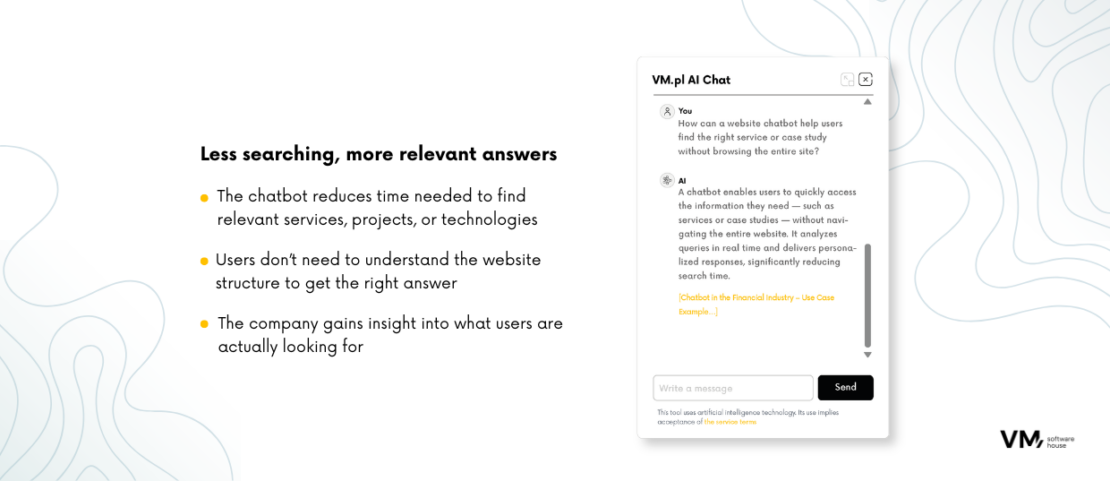
- Instant access to accurate information – in seconds, not minutes
- Access not only to basic company details, but also to project history (case studies), technologies, and team information
- No need to browse the entire website – interactions are more intuitive and efficient
For the company
- Visibility into customers’ most frequent questions – helping plan communications and offers
- Identification of offer gaps or areas needing development (technologies, services, skills)
- Strengthening the brand as a modern, tech-savvy company that “practices what it preaches”
- Ability to scale customer service without proportional increases in staffing costs
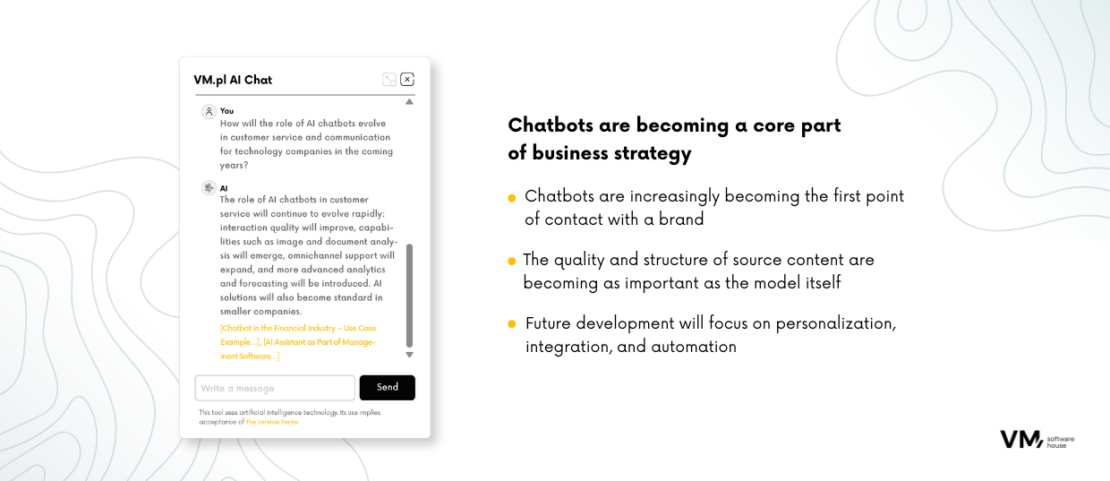
The Future of AI Chatbots in Customer Service
Chatbots are rapidly evolving from basic informational tools into intelligent assistants supporting customer service, marketing, and internal processes. The next few years will see growth in five key areas: conversation personalization, omnichannel integration, voice communication, task automation, and data security.
A notable trend is Microsoft’s initiative to launch a new website format designed specifically for chatbots. These sites will include metadata that describes the structure and meaning of content in ways that language models can understand. This marks a shift toward an AI-oriented internet — not only for users but also for systems that process and interpret data.
At VM.pl, we’re following this trend closely. We aim to be one of the first companies in Poland to implement solutions that help create and optimize content specifically for chatbot and AI assistant interactions. Our goal is for AI-driven solutions not only to answer questions but to actively support the business strategies of our clients.
Summary
The AI Chat project is an example that proves we don’t just implement AI for clients — we use it ourselves, showing we understand the inner workings, challenges, and advantages of such technologies.
If you’re planning to implement an AI chatbot in your organization or are looking for a partner to help you unlock the practical value of artificial intelligence – contact us. We’ll be happy to share our experience from the AI Chat project and help you choose a solution aligned with your business goals.
