


This website uses cookies so that we can provide you with the best user experience possible. Cookie information is stored in your browser and performs functions such as recognising you when you return to our website and helping our team to understand which sections of the website you find most interesting and useful.
Category:
Artificial Intelligence
Industry:
Transportation & Logistics
Client
The project was delivered for an organization seeking to implement a real-time video analysis system for monitoring and vehicle counting purposes.
Challenge
With the growing use of video surveillance systems in areas such as public safety, traffic analysis, and agricultural monitoring, the need emerged for a tool capable of real-time video stream analysis. The key requirements included high-precision object detection and tracking, support for multiple operation modes, handling of multiple video sources, and browser-based access to the service.

Solution
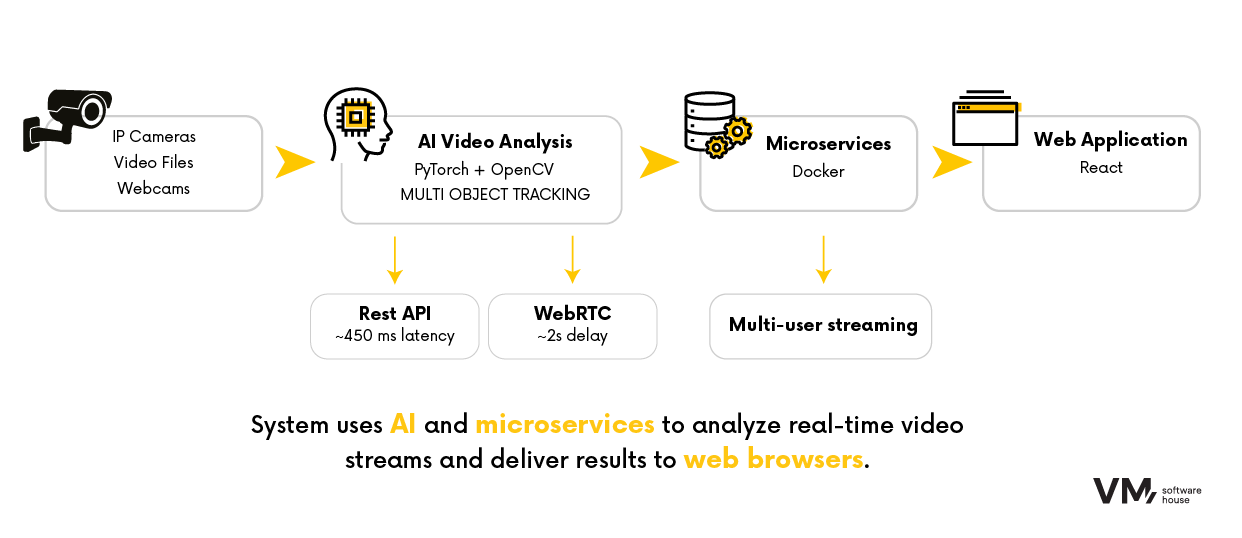
A real-time vehicle tracking application was designed and deployed — adaptable to other object types (people, animals, plants) and scalable across various business scenarios. The system is built on a microservices architecture, where each component runs in an isolated Docker container. It integrates a deep learning-based object detector and multi-object tracking system.
The application operates in three core modes:
- Single image detection via REST API with ultra-low latency (~450 ms),
- Peer-to-peer streaming with end-to-end latency of approximately 2 seconds,
- Client-server streaming architecture, optimized for a wide range of user devices.
The system supports multiple video sources (IP cameras, webcams, video files) and allows multiple clients to simultaneously access an annotated stream. Bidirectional communication enables real-time analysis and seamless result delivery directly to the user’s browser.
Results
The system enabled:
- Counting vehicles moving in any user-defined direction,
- differentiation between vehicle types (cars, trucks, motorcycles),
- reliable performance in both local and internet-based streaming environments,
- fast adaptation to other use cases (e.g., detection of people or animals), making it a versatile tool for multiple industries.
Technology
The system was developed using:
- Frontend: React.js, TypeScript, Redux, Redux-Saga, Styled-Components
- Backend: Python, PyTorch, OpenCV, AsyncIO, Multiprocessing
- Video streaming: WebRTC and HLS
- Infrastructure: Microservices deployed in Docker containers


How We Improved the Development and Maintenance of an ERP System in a Legacy Application
Design, Development, DevOps or Cloud – which team do you need to speed up work on your projects?
Chat with your consultation partners to see if we are a good match.