


This website uses cookies so that we can provide you with the best user experience possible. Cookie information is stored in your browser and performs functions such as recognising you when you return to our website and helping our team to understand which sections of the website you find most interesting and useful.

Category:
Artificial Intelligence
Industry:
Healthcare
City:
Oklahoma, USA
Client
The client is a U.S.-based healthcare company that processes a high volume of financial documents daily, including payment confirmations and insurance settlements. While most of its operations are already automated and rely on structured electronic document exchange formats (such as EDIFACT), ensuring seamless communication and high operational efficiency, a persistent challenge remained: handling unstructured documents. These include scanned pages, printed forms, or image-based files, which required manual processing—limiting scalability and consuming valuable human resources.
Challenge
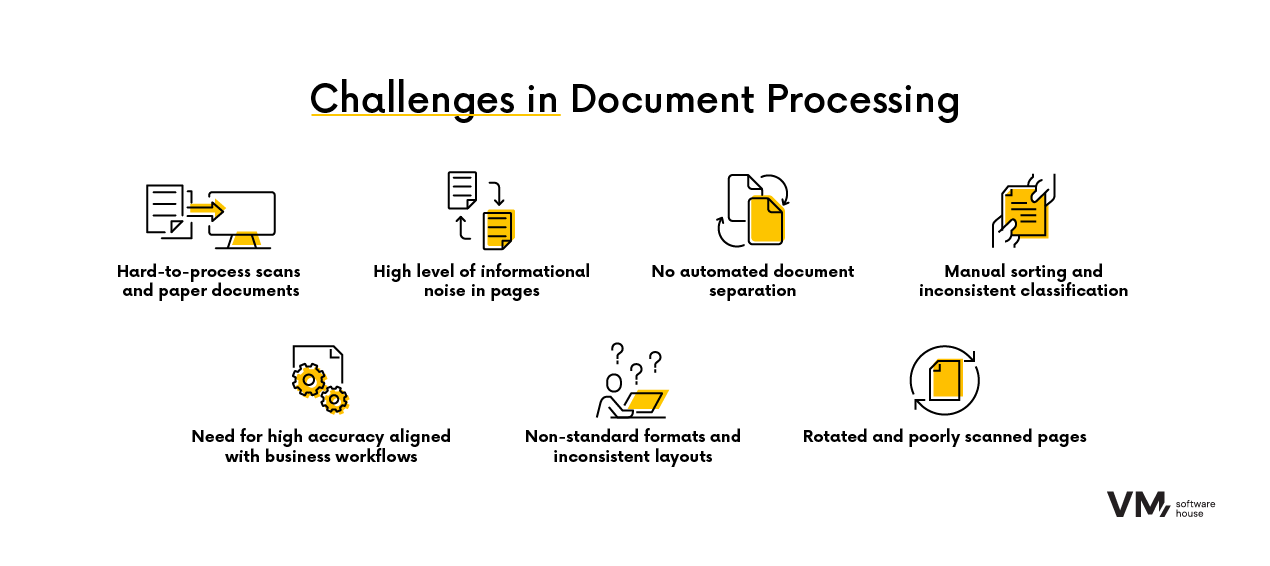
The primary goal was to automate the separation and classification of multi-page paper and scanned documents. The solution needed to handle noise (e.g., irrelevant pages, rotated scans, varying layouts) while delivering high accuracy in detecting document boundaries and assigning them to the correct categories. This required advanced image and text processing combined with a deep understanding of the client’s internal business workflows.
Solution
The project was executed in several stages, combining data exploration, the development of machine learning (ML) models, and business-specific logic tailored to the client’s needs.
The implemented solution included:
- Development of models to detect document boundaries within page streams, using binary classification of page pairs—comparing adjacent pages to determine whether they belong to the same document. This enables automatic grouping of pages into discrete document units
- Creation of document classification models to route documents into appropriate categories—e.g., invoices to accounting, forms to billing—eliminating manual sorting and delays.
- Fine-tuning transformer-based models, modern AI algorithms capable of interpreting layout and textual content similarly to a human (Document AI). Training these models on the client’s data significantly improved precision.
- Designing post-processing rules to align model outputs with business expectations. For example, a document lacking a specific reference number may be flagged for review even if the model deemed it correct.
Additionally, the project involved:
- Exploratory Data Analysis (EDA) and data quality assessment,
- Filtering out pages containing irrelevant noise,
- Iterative development and testing of separation and classification models,
- Implementing an application that integrates these models into the client’s operational systems.
Together, these elements form a flexible system that not only identifies and classifies documents but also supports downstream processing based on business rules.
Results
Thanks to the deployed system, the client achieved significant operational improvements:
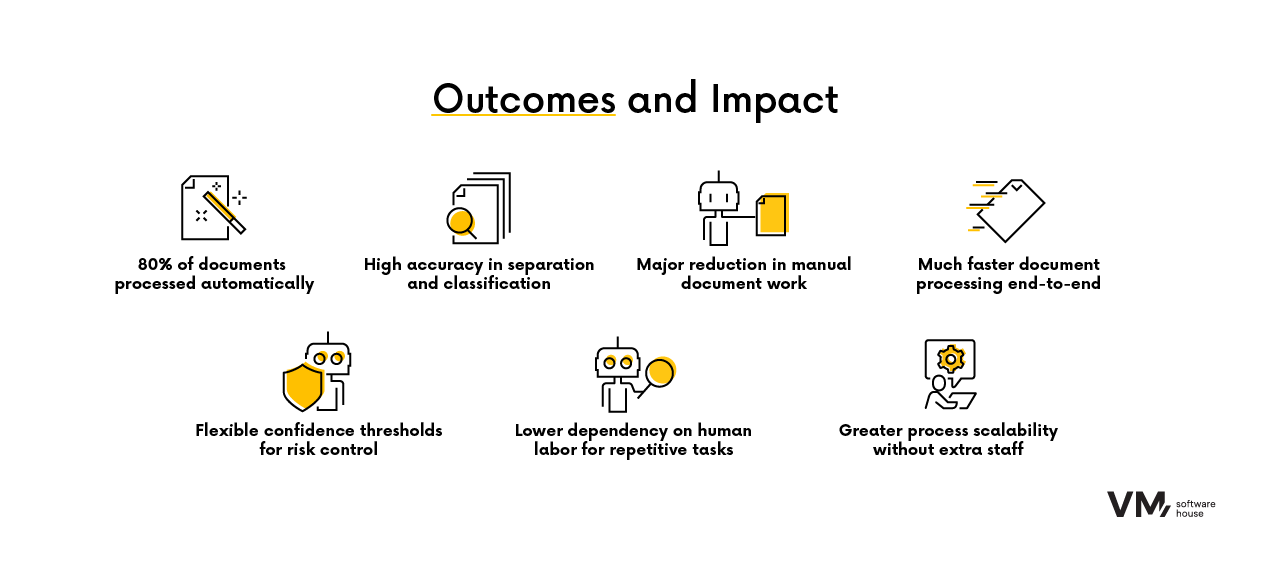
- Over 80% of documents were processed without human intervention,
- High accuracy in document classification and boundary detection was observed on test datasets,
- Manual processing time and workload were significantly reduced,
- Customizable confidence thresholds allow for fine-tuning automation levels based on operational risk.
Business Impact:
- Improved process scalability without proportional staff increases,
- Faster document handling and smoother transaction flows,
- Reduced reliance on manual labor for time-intensive operational tasks.
Technologie
The solution is built on advanced document processing techniques and multimodal data integration:
- OCR (text recognition), bounding boxes (text position metadata), and visual scans as multimodal input,
- Page-level embedding aggregation using pooling, attention layers, and Bi-LSTM networks,
- Document separation via binary page-pair classification,
- Fine-tuned transformer architectures adapted to the healthcare domain.
The model and its components were fully aligned with the client’s business processes, making the solution both effective and replicable across other industries where paper documentation remains prevalent—such as logistics or public administration.

Design, Development, DevOps or Cloud – which team do you need to speed up work on your projects?
Chat with your consultation partners to see if we are a good match.