


This website uses cookies so that we can provide you with the best user experience possible. Cookie information is stored in your browser and performs functions such as recognising you when you return to our website and helping our team to understand which sections of the website you find most interesting and useful.

Category:
AI Agile Transformation
Industry:
Manufacturing, Printing
City:
Dresden, Germany
Client
Saxoprint GmbH is a large printing company based in Dresden, specializing in online printing services for business customers across Europe. The company combines state-of-the-art technology with a broad portfolio of print products and delivers its services primarily through online channels.
Challenge
Before the collaboration began, the IT team faced several organizational and technological challenges that significantly impacted both the speed and quality of their work. The key challenges included:
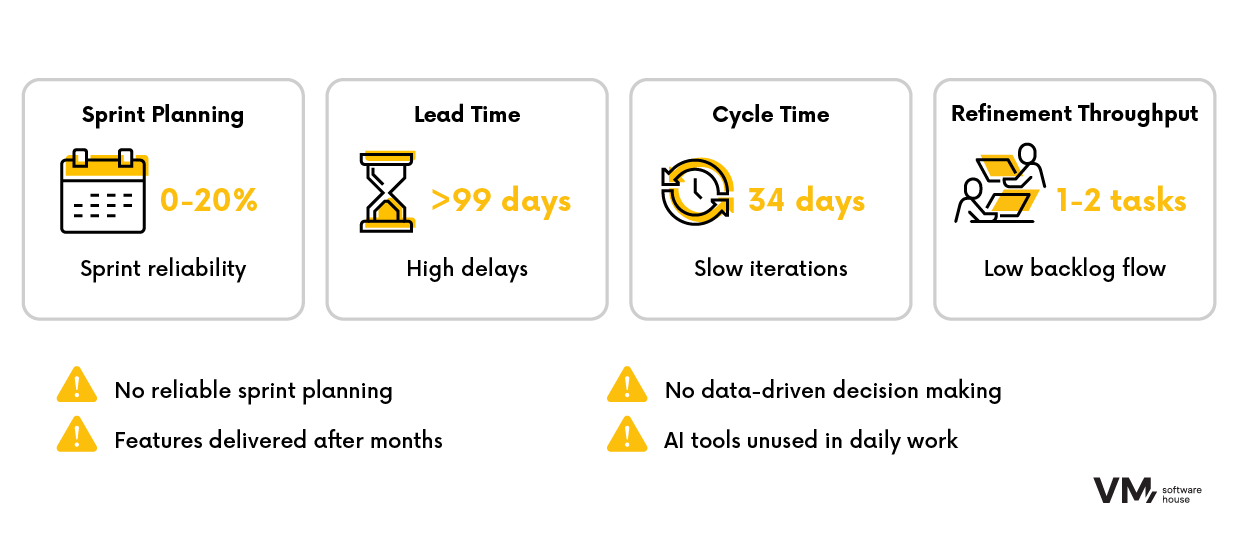
- Low delivery predictability – There were no measurable entry criteria (Definition of Ready); the backlog was unstable and refinements were ineffective, making sprint planning difficult.
- Limited use of metrics – Without regular KPI analysis, process bottlenecks could not be identified, and decisions were driven more by intuition than by data.
- Low velocity – On average, only 1–2 very large items were handled per refinement session, limiting backlog readiness and affecting sprint goal achievement.
- Long Lead Time and Cycle Time – The time from request intake to implementation was too long and difficult to forecast.
- Unclear roles and responsibilities – There was no shared understanding of the Product Owner, Project Manager, and Scrum Master roles, leading to duplicated efforts or decision gaps.
- No operational AI adoption – Despite the availability of tools such as GitHub Copilot, the team lacked the knowledge and practices required to use them effectively in daily workflows.
Solution
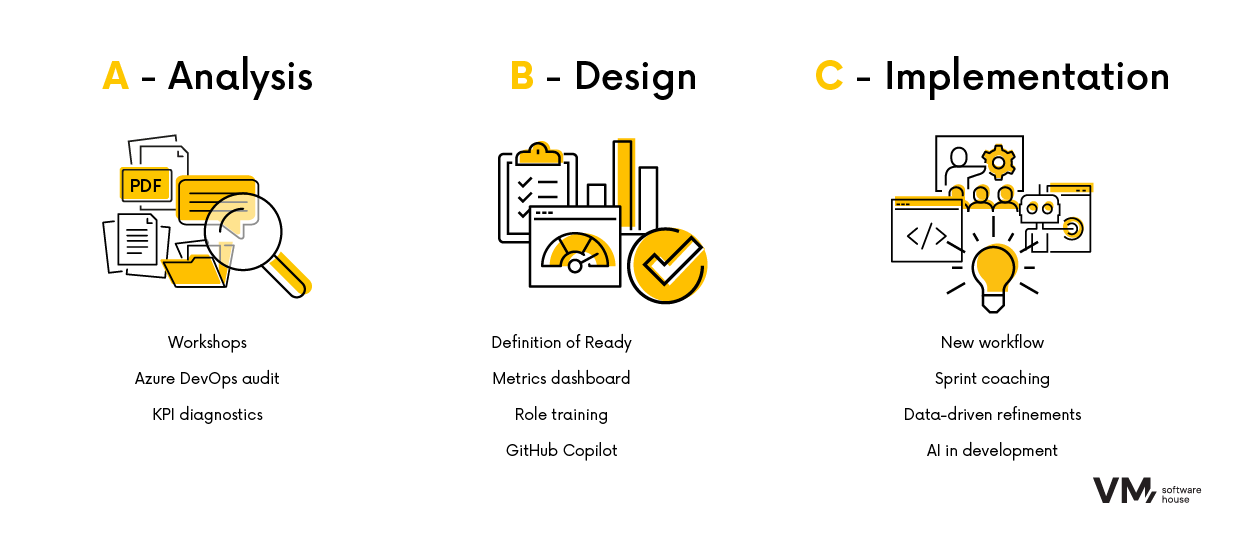
The project was divided into three main phases: Analysis (Phase A), Solution Design (Phase B), and Coaching & Implementation (Phase C). This structured approach enabled a gradual, practical, and sustainable optimization of team processes at Saxoprint.
Phase A – Analysis
We began with a detailed assessment of the team’s current state, its processes, tools, and challenges. A central objective of this phase was a thorough analysis of the existing use of Azure DevOps. Through a series of workshops, interviews, and reviews of project artifacts (task boards, backlogs, sprint documentation), a comprehensive understanding of the existing issues was developed.
The outcome of Phase A was a clear overview of the initial state of processes, tools, and organizational capabilities at Saxoprint. The combination of team workshops and technical analysis created a reliable, data-driven foundation for the next phase of the transformation.
Phase B – Solution Design and Training
Based on the insights from Phase A, a detailed plan for process and technology transformation was developed. Phase B was a critical preparation step in which the client’s domain expertise was combined with the consultants’ experience in Agile and AI.
Together with the team, the following measures were implemented:
- Definition of “Definition of Ready” (DoR) criteria – Minimum requirements were established for tasks to be eligible for sprint planning. This led to higher backlog quality and the elimination of unprepared items.
- Development of a metrics model and inspection cadence – A system for continuous monitoring of Velocity, Lead Time, Cycle Time, and Scope Increase was introduced. The KPI dashboard was built based on data from the ticketing system and Azure DevOps.
- Establishment of coaching priorities for the Product Owner, Project Manager, and Scrum Master roles – Development cycles were planned with a focus on process ownership, refinement facilitation, and sprint planning and inspection.
- Identification of key technical competencies within the development team – Special focus was placed on the productive use of GitHub Copilot, prompt engineering, refactoring, and unit testing.
- Reconfiguration of Azure DevOps and creation of a technical guideline – Azure Boards was optimized to fully leverage the new work hierarchy and Delivery Plans. An accompanying handbook serves as a central knowledge source, ensuring a consistent understanding of backlog structures and work item conventions, thereby increasing transparency across the entire project.
Phase B was also the point at which internal stakeholder alignment was secured – the Product Owner, Project Manager, and Scrum Master actively participated in the process design, significantly increasing commitment to the upcoming implementation phase.
Phase C – Coaching and Implementation
This was the most intensive phase of the collaboration, during which the Saxoprint team fully implemented the previously designed improvements. The objective was not only to introduce new tools and processes but also to embed a new working culture within the team.
Activities included two sprint packages:
- Package 1 – Stabilization: Introduction of a new workflow, implementation of the Definition of Ready, activation of the KPI dashboard, and backlog cleanup.
- Package 2 – Optimization: Reinforcement of process discipline, improvement of refinements, introduction of AI tools, and preparation for scaling.
Key initiatives:
- Training and coaching for PO/PM/SM – The Product Owner, Project Manager, and Scrum Master participated in targeted coaching sessions focused on process ownership, sprint facilitation, KPI analysis, and response to disruptions. Their engagement was critical to the sustainability of the changes.
- Strengthening team practices – Scrum meetings were structured and supplemented with KPI analysis, enabling better responsiveness and progress control.
- Data-driven refinements – The team used the Definition of Ready as a task selection criterion, increasing efficiency and significantly reducing unplanned interruptions during sprints.
- AI enablement and competency development – Developers were trained in GitHub Copilot usage, prompt engineering, and context management. Best practices were documented to support scalability.
- Cross-functional collaboration – Architects, PO, PM, SM, and developers worked together to finalize technical documentation, Copilot usage guidelines, and team-wide working standards.
Phase C concluded with a comprehensive KPI audit confirming significant improvements in delivery times, predictability, and overall work quality. All measures created a solid foundation for further scaling of the transformation within the organization.
Results
During Phase C, measurable improvements were achieved in the most critical areas of team performance, confirmed by a comprehensive KPI audit:
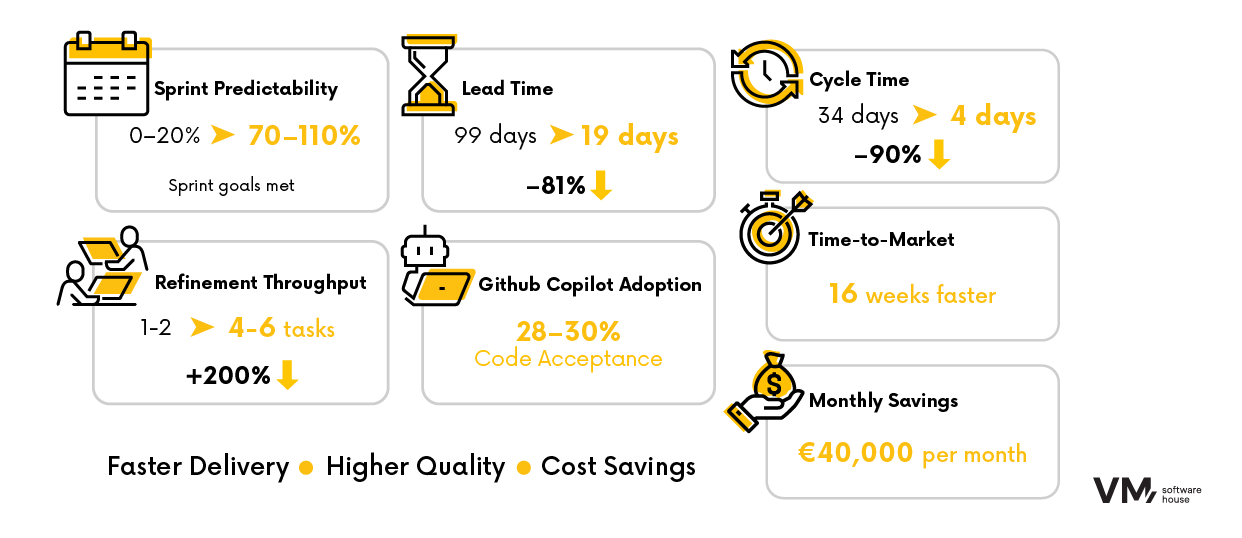
- Sprint predictability more than tripled. Previously, only 0–20% of planned story points were completed; after the transformation, the team consistently achieved 70–110% of sprint goals.
- Feature delivery time was drastically reduced. Lead Time for user stories decreased from over 99 days to 19 days — a reduction of approximately 81%.
- Cycle Time was also significantly reduced: the processing time for user stories dropped from 34 days to just 4 days — an efficiency increase of nearly 90%.
- Backlog quality and overall team performance improved substantially. The number of tasks prepared per refinement increased from 1–2 to 4–6, representing a throughput increase of over 200%.
- AI adoption showed stable and productive usage patterns. The average acceptance rate of code generated by GitHub Copilot remained consistently at 28–30%, while prompt accuracy improved — reflected in an increase in accepted lines of code from 29% to nearly 33%.
- The roles of the Product Owner, Project Manager, and Scrum Master were strengthened through targeted coaching. Their active process ownership was a decisive success factor in ensuring the sustainable implementation of the changes.
Through structured guidance during the Agile Transformation, the Time-to-Market for internal initiatives was significantly reduced within just 16 weeks. This enabled the faster implementation of a process optimization that now secures sustainable savings of €40,000 per month.
From the customer
“We felt the improvement in our time-to-market immediately. Our very first initiative after the agile transformation was completed much faster than we were used to. That meant we were able to realize cost savings of €40,000 a full month earlier. With Azure DevOps and the new dashboards, I finally have clear visibility: I can instantly see what’s happening, when it’s happening, and where we currently stand. That gives me confidence that high-priority features are being delivered quickly and on schedule.”
Ijad Nestler
Executive Management
Client

Design, Development, DevOps or Cloud – which team do you need to speed up work on your projects?
Chat with your consultation partners to see if we are a good match.