








 AI/ML
AI/ML  Software Development







Industrial AR glasses
Real-time remote support with audio-video streaming and hands-free annotation
Augmented reality that accelerates training, assembly, and technical support
Why Does This Solution Matter?
From Costly Training and Travel to a 24/7 Digital Instructor
Traditionally, training required the physical presence of an instructor, available facilities, and limited seating capacity. The process was difficult to scale, costly, and prone to inconsistencies in knowledge transfer. Technical support often meant expert travel and the risk of production downtime.
With AR glasses, employees receive instructions directly at the point of task execution, in real time and in a standardized format. An expert can remotely supervise the work, see exactly what the operator sees, and immediately indicate the correct actions.
The organization shifts from a model dependent on physical presence and limited resources to a scalable, measurable, and significantly more efficient training and service process.
Operational Breakthrough
Augmented reality enables knowledge transfer directly at the place of work.
Instructions appear as semi-transparent overlays, including:
The operator sees the real environment while simultaneously receiving real-time support.
What challenges do our clients face?
Rapid Training at Scale
Example: training 800 operators within a short timeframe.
Traditional methods do not allow parallel training of multiple groups without increasing the number of instructors.
High Operational Costs
Lack of Standardization
Different instructors = different training quality.
Subjectivity in knowledge transfer directly impacts quality and workplace safety.
Risk of Assembly Errors
In complex projects (e.g., installation of a production line), a single mistake can result in:
Logistical and Pandemic Constraints
Limited ability for international experts to be physically present on-site.
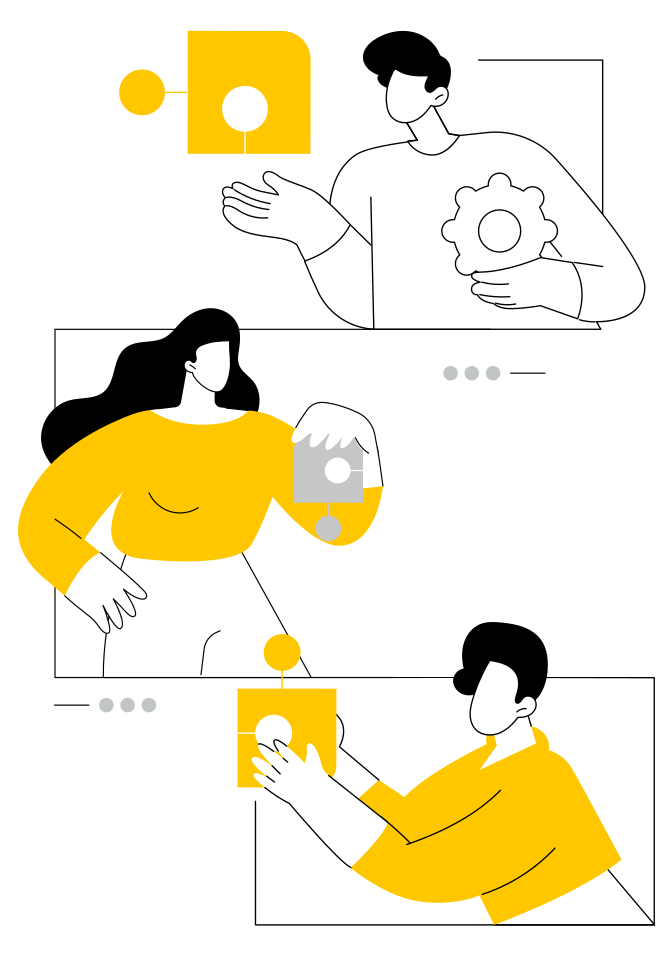
How Does Our AR Solution Work?
Real-Time Digital Instructor
The system guides employees step by step, showing exactly what to do and where.
Automatic Compliance Verification
Ceiling-mounted or device-mounted cameras analyze operator movements, including:
Even older machines without digital interfaces can be analyzed using Computer Vision technology.
Compliance with Occupational Health & Safety Standards
Industrial-grade AR glasses (e.g., RealWear) can be used with helmets, gloves, and protective eyewear.
Online and Offline Operation
The system functions even with limited connectivity — critical in industrial environments.
Digital Audit and Data Analytics
A complete training record enables:
Remote Expert Support (AR Remote Support)
An expert located in another country can see the operator’s camera feed and:
Metodology 4D

Discovery
Understanding the DNA of the problem before the first line of code is written
The Discovery phase allows for a deep understanding of the business challenge, user needs, and technological context. As a result, the project starts on solid foundations, and key assumptions are validated before development begins.
Key artifact
Standardized Concept Document

Our focus
Our activities
We analyze the client’s business and technological environment
— from existing systems to user needs and strategic goals. We validate business assumptions, identify risks, and define the problem to be solved. The outcome is a coherent product concept that forms the foundation for the next stages of the project.

Definition
Translating knowledge and ideas into a concrete product plan
In the Definition phase, we transform insights from Discovery into a detailed solution design. This includes defining requirements, system architecture, and the user experience concept.
Key artifact
Product & Architecture Blueprint
Our focus
Our activities
We translate business goals into specific functional and technical requirements. We design UX prototypes, define the architecture, and plan the project implementation. This ensures development starts with a clear plan and minimal risk.

Delivery
Building and delivering reliable software
In the Delivery phase, we develop the final solution. We focus on code quality, clear communication with stakeholders, and a stable product release.
Key artifact
Production-ready product / deployment
Our focus
Our activities
Our teams build the solution using modern development practices and continuous integration. We regularly test the product and maintain transparent communication with stakeholders to deliver a stable, production-ready solution.

Direction
Transforming a product into a growing digital business
Direction is a phase of long-term product development. Instead of ending cooperation after implementation, we support clients in scaling solutions, introducing innovations, and building a competitive advantage.
Key artifact
Product development and innovation roadmap
Our focus
Our activities
Together with the client, we analyze product data, identify new growth opportunities, and plan future functionalities. We help scale the solution, optimize its performance, and build a long-term product strategy.
Business value – real numbers
- Training for over 800 employees
- Reduction of training time from several days to a few hours
- Cost reduction of over €100,000
- Savings of approx. €130 per employee
- Elimination of international expert travel costs
- Shorter production line setup time
- Reduced risk of assembly errors
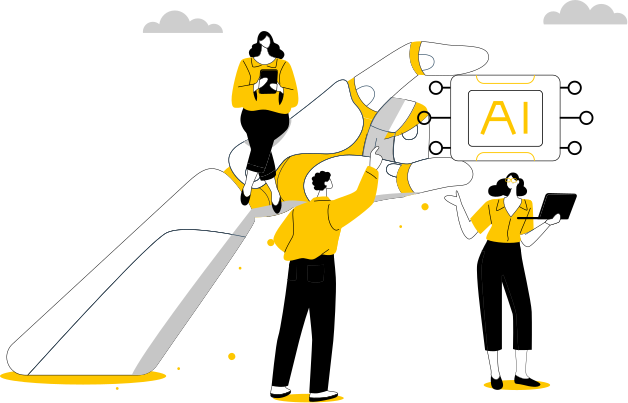
See where AR Glasses are used
AR glasses are a practical implementation of augmented reality that combines:
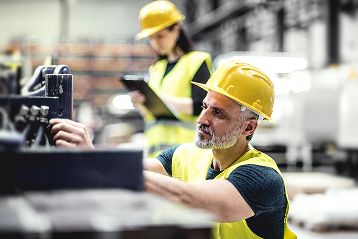
onboarding of production employees

remote service support
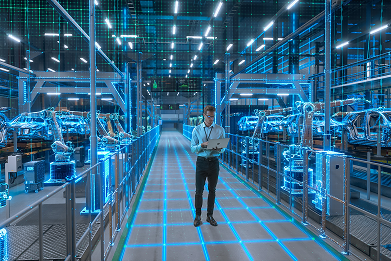
installation and commissioning of production lines
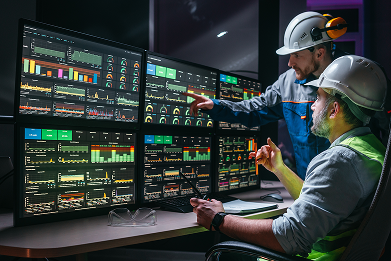
maintenance
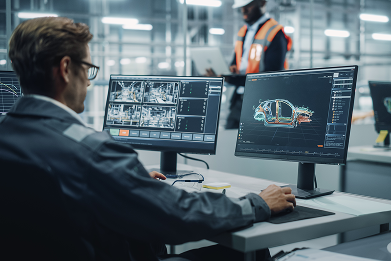
industrial production
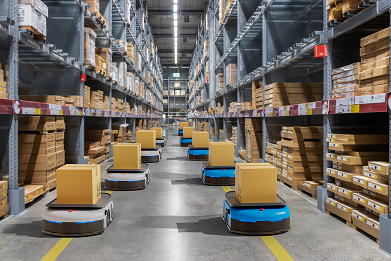
logistics and warehousing