










 AI/ML
 Software Development


Comprehensive Programming and Commissioning of a New Production Line
Client
BMW is one of the world’s leading manufacturers of premium vehicles, recognized for its high quality standards, precision in production processes, and advanced automation.
Challenge
As part of expanding its manufacturing capacity, the company launched a project to commission a new production line. The key objective was to ensure full operational readiness before the start of serial production, while maintaining the rigorous technical and programming standards required within BMW’s organization.
The project required specialized support in programming and commissioning industrial automation systems.
Launching a new production line in the automotive environment demands precision, experience, and excellent coordination. Even minor errors in control logic, hardware configuration, or system communication can result in production start delays or operational issues at later stages.
Commissioning a production line also requires coordinating electrical installation, equipment configuration, and control software testing. These activities often take place in parallel, so PLC programmers must continuously verify that the controllers work correctly with sensors, drives, and other infrastructure components. Errors identified at this stage can affect subsequent production sequences and delay the line’s readiness for final acceptance.
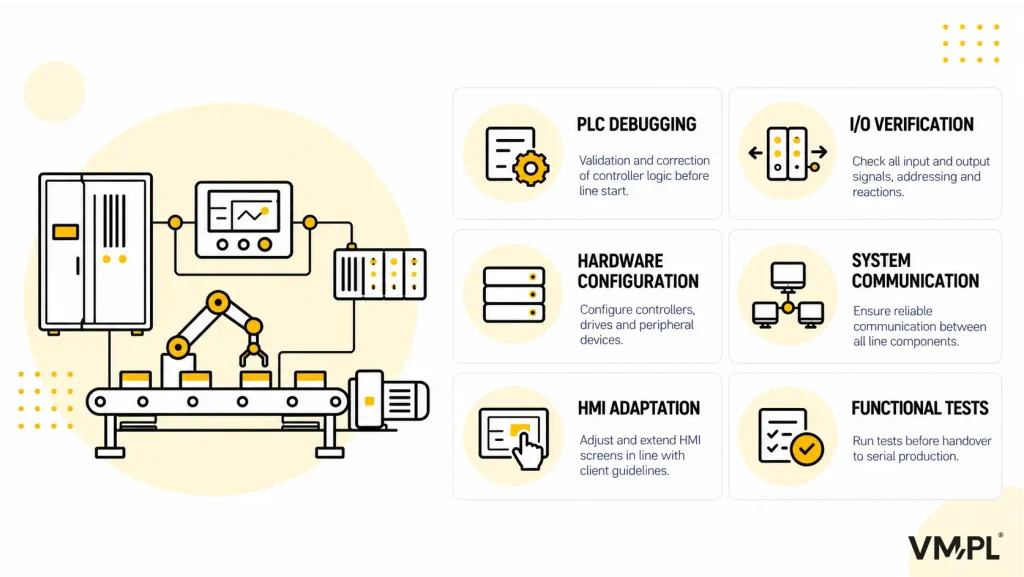
The scope of challenges included:
- detailed debugging and validation of PLC control programs,
- verification of all input/output (I/O) signals,
- configuration of controllers, drives, and peripheral devices,
- ensuring proper communication between system components,
- customization and development of the HMI in line with client guidelines,
- conducting functional tests prior to handing over the line to production.
The project was executed under significant time pressure, as the production line commissioning schedule was closely aligned with the plant’s production plans. Minimizing downtime risk and ensuring stable system performance from day one were critical priorities.
Solution
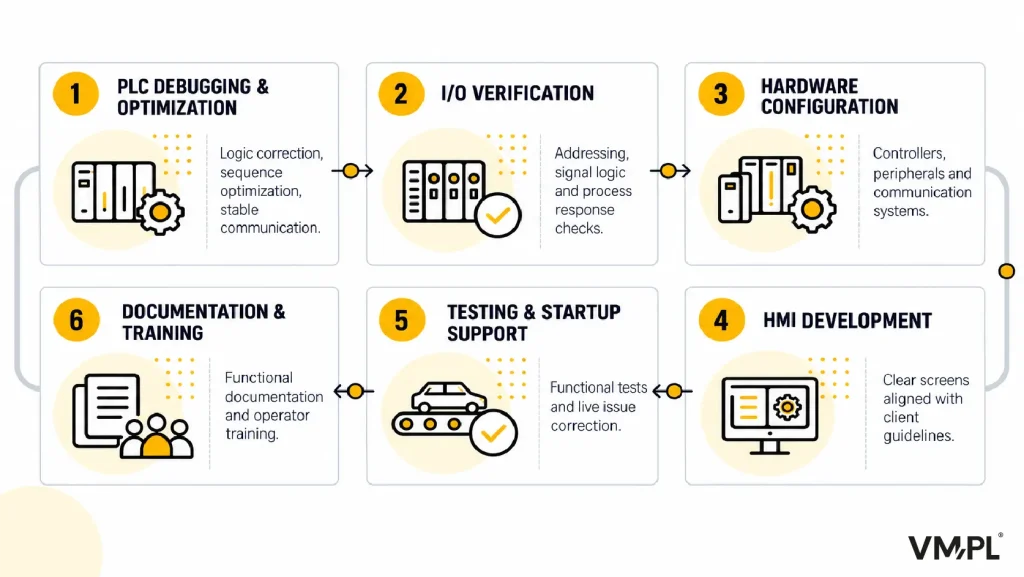
The team assumed full responsibility for comprehensive support of the production line commissioning process – from control system analysis to final start-up support.
Our scope included:
PLC Debugging and Optimization
We conducted a detailed analysis and correction of PLC control code. The focus was on eliminating logical errors, optimizing control sequences, and ensuring stable communication between system components.
I/O Signal Verification
We performed full validation of input and output signals, verifying correct addressing, operational logic, and system responses to process signals. This allowed potential irregularities to be eliminated before serial production began.
I/O verification involves checking the physical connections between devices and PLC controllers. This includes activating individual sensors and verifying that their signals appear at the correct PLC addresses. The responses of actuators to control signals are also tested.
This process helps identify errors in wiring, addressing, or device configuration that could cause the machine to malfunction even when the PLC program itself is correctly written.
Hardware Infrastructure Configuration
We were responsible for configuring controllers, peripheral devices, and communication systems in accordance with the production line architecture and BMW standards.
Hardware infrastructure configuration involved preparing PLC controllers, peripheral devices, and communication systems to work together within the production line, in accordance with the system architecture and BMW standards.
At this stage, proper device addressing, drive and variable frequency drive (VFD) parameterization, and verification of communication between controllers and other components are particularly important. Each component must be configured according to the process requirements to ensure that the programmed control sequences execute correctly.
HMI Development and Customization
We designed and customized the HMI interface to meet client requirements, ensuring clear process visualization, intuitive operation, and compliance with corporate guidelines regarding ergonomics and screen structure.
An important part of HMI verification is ensuring that equipment status information, alarm messages, and interface responses to events occurring during production line operation are displayed correctly. Operators should receive information that accurately reflects the current state of the control system, enabling them to operate the equipment properly and quickly identify any issues.
Testing and Start-Up Support
We actively supported the production line launch by conducting functional tests, resolving ongoing issues, and collaborating closely with the client’s engineering team.
Once the initial equipment configuration is complete, it is essential to verify the operation of entire production sequences. Testing helps determine whether individual stations exchange signals correctly, perform operations in the proper order, and respond according to the programmed PLC logic.
This approach helps identify issues that may not be apparent when testing individual components but only become evident when multiple devices operate together as part of the same production line.
Documentation and Training
We prepared complete functional documentation and delivered training sessions for operators and the maintenance department, enabling the client’s team to efficiently and independently manage the system after project completion.
Results
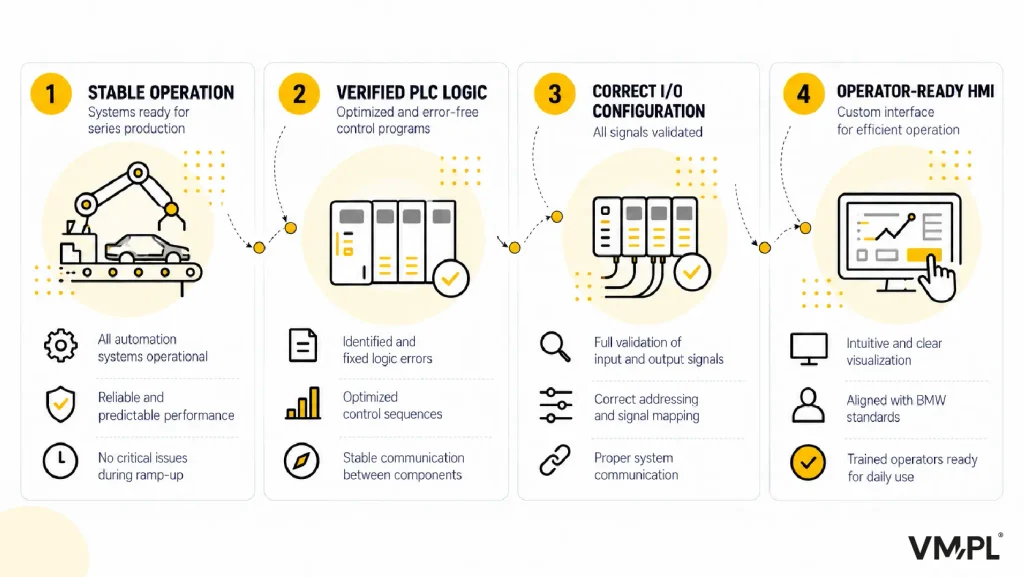
As a result of the implemented activities, the new production line was commissioned in a stable manner and in full compliance with BMW’s technical requirements.
The project delivered the following operational outcomes:
- full readiness of automation systems for serial production,
- stable and predictable PLC program performance,
- properly verified and configured I/O signals,
- an intuitive HMI interface supporting efficient operator workflows,
- reduced risk of errors and downtime during production start-up,
- well-structured technical documentation supporting ongoing maintenance and further development,
- trained personnel prepared for daily system operation.
Thanks to the team’s expertise and close collaboration with the client, the project concluded with the handover of a fully functional and optimized production line ready to operate in the demanding automotive environment.
How We Reduced the Evaluation of 13 ERP Proposals From One Month to 3 Days
Design, Development, DevOps or Cloud – which team do you need to speed up work on your projects? Chat with your consultation partners to see if we are a good match.
Jakub Orczyk
Member of the Management Board/ Sales Director VM.PL
Book a free consultation