







 AI/ML
AI/ML  Software Development






Help Desk for the Factory – Intelligent Maintenance Support Powered by AI and Shop Floor Expertise
Client
One of the European manufacturing sites of a major pharmaceutical company, specializing in the industrial production of solid dosage forms (e.g., tablets and capsules), was seeking a way to reduce response times during emergency situations. Due to the large scale of operations and complex machine infrastructure, the maintenance team needed a tool that would enable fast and secure access to knowledge—regardless of shift, tenure, or employee experience level. The team’s daily work relies on extensive technical documentation maintained in multiple languages.
Challenge
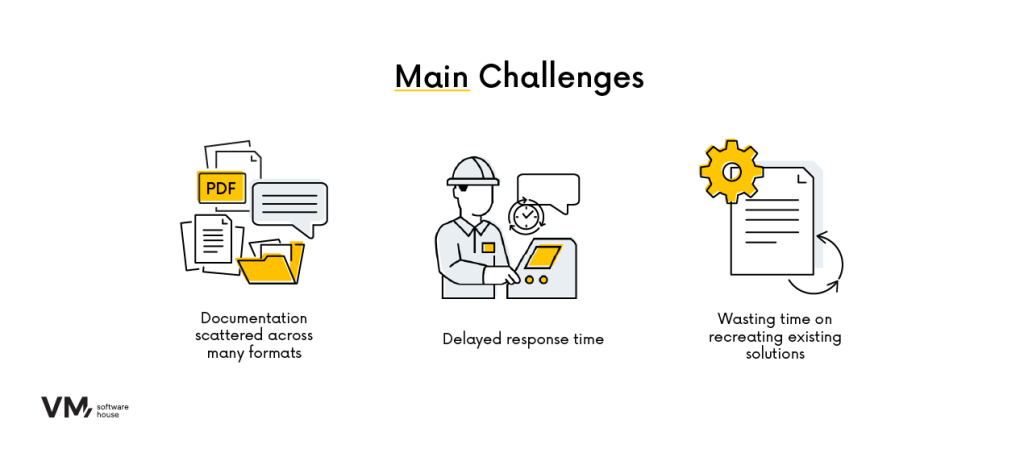
A machine failure in a manufacturing facility demands an immediate response. Unfortunately, access to critical information was fragmented:
- technical documentation existed in multiple formats,
- failure history was stored across separate systems,
- operational know-how was undocumented and “scattered across shifts”.
As a result:
- response times were too long,
- diagnoses were often based on intuition or incomplete data,
- the service team spent valuable time searching for information or consulting colleagues,
- potential solutions were frequently repeated or reinvented from scratch.
An additional challenge was employee turnover. When an experienced technician left the company, their practical knowledge often left with them. New employees had to learn from scratch, often relying on the limited number of experts available during their shift.
The goal of the project was to create a system that:
- integrates documentation, incident history, and technical notes in one place,
- allows employees to ask questions in natural language and receive accurate answers,
- is available 24/7 and easy to use, even for non-technical staff,
- the solution operates exclusively on the company’s internal documentation, not on internet resources,
- complies with IT security policies and can be deployed on-premises.
Solution
In response to the client’s needs, we developed OEE Booster– an AI-powered Help Desk system designed to support maintenance operations and simplify the daily work of technical teams.
OEE Booster is built on a Retrieval-Augmented Generation (RAG) architecture. The system does not generate random responses, but instead searches through documents, tickets, and other approved resources, then formulates answers to the given questions by referencing specific sources such as PDFs, support tickets, or system logs. Thanks to the use of Large Language Models (LLMs), the responses are precise and contextually accurate.
The system does not replace existing tools such as ERP, MES or CMMS. Instead, it provides an intelligent layer for accessing and using the knowledge available within these systems, bringing information from multiple sources together in a single place.
The implementation began with a pilot covering a selected production hall and specific machine types. This made it possible to quickly validate the value of the solution before committing to a full-scale rollout. Within eighteen months, the project expanded to cover the entire plant. Today, the system is used daily by both machine operators and maintenance engineers.
Key Features of the System
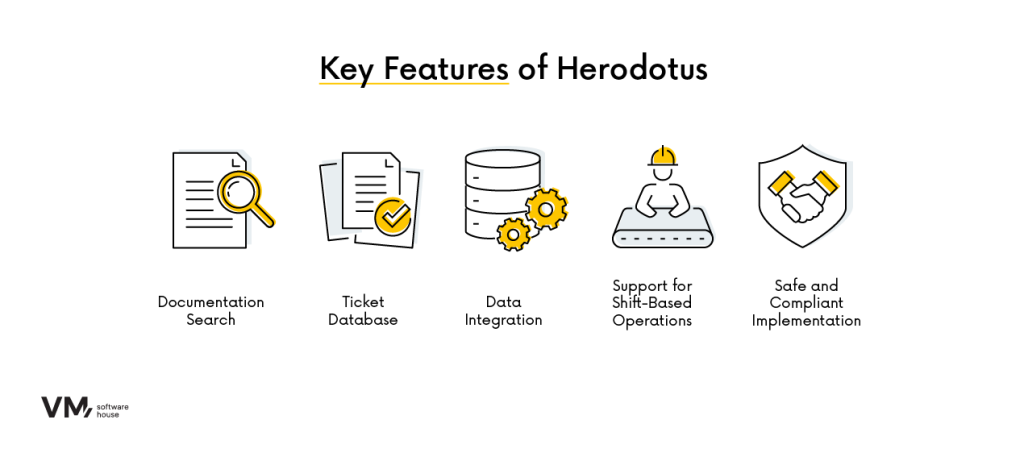
- Manufacturer Documentation Search
Users don’t need to know file structures or folder names—just ask a question in natural language. The RAG-based system locates the relevant section of the manual or technical diagram. Supported formats include PDF, Word, Excel, text files, exported procedures, as well as scanned documents and images through built-in OCR capabilities. For example, an operator can ask, “What steps are required before cleaning this machine according to the SOP?” and immediately receive an answer with a reference to the relevant document. - Ticket Database
All past incidents and their resolutions are stored in one place, ready to be reused whenever a similar issue arises. Historical cases and lessons learned from incidents can be continuously added, creating an ever-growing knowledge base of proven solutions. - Integration of Multiple Sources
OEE Booster, powered by RAG, connects documentation, repository files, service bulletins, checklists, and logs, eliminating the need for manual searches across systems. Integration with SharePoint, DMS, CMMS and other internal enterprise systems is supported. New documents are indexed automatically, while previous versions are replaced as soon as an updated file is uploaded. - Barrier-Free Shift Work
The RAG-based system is available at all times, across all shifts, ensuring every user accesses the same, up-to-date knowledge base. Every shift has immediate access to the activity history of the previous shift. Queries can be submitted in any language. The system responds in the user’s preferred language, even if the source documentation is written in another language. - Secure Deployment and Quality Control
OEE Booster operates within a “restricted context”, it processes only client-provided data and never generates answers from outside the defined knowledge base. The system runs either in a private cloud environment with infrastructure located within Europe or on-premises, depending on the organisation’s requirements. - Role-based access
Separate views and permissions can be configured for maintenance engineers, maintenance technicians and machine operators. Dedicated AI assistants can also be created for different roles or production lines. Maintenance engineers receive concise, technical answers, while operators receive more descriptive responses written in clear, easy-to-understand language.
Results
Reduced diagnosis and repair time (MTTR – Mean Time To Repair)
By centralizing knowledge and providing access to previous incidents, technicians can identify root causes and take corrective actions much faster.
Downtime reduction by 50–70%
The system significantly shortens reaction time in critical situations, directly improving machine availability and overall line productivity.
Up to 40% of breakdowns resolved without maintenance team involvement (Maintenance Department)
Line operators can now fix many issues independently as part of Autonomous Maintenance (AM), using verified knowledge stored in the system.
Support for preventive and continuous improvement initiatives
OEE Booster assists in performing Root Cause Analysis (RCA), generating Kaizen improvement ideas, and providing topics for TPM (Total Productive Maintenance) and RCM (Reliability-Centered Maintenance) meetings, reinforcing a culture of continuous improvement and standard work practices.
Knowledge retention and accessibility
Maintenance know-how is preserved, searchable, and always up-to-date, even as personnel change over time.
Secure AI implementation in industrial environments
OEE Booster complies with IT security policies and can be deployed either on-premise or in the cloud (e.g., Azure), ensuring full data control.
Collaboration Model
Full Deployment Tailored to the Plant’s Reality
We begin with an in-depth analysis of available resources—technical documentation, incident databases, work files, and procedures. Based on this, we configure the system to fit the specific processes and needs of the maintenance team.
Team Training
We provide hands-on training for technical staff. We teach not only how to ask questions of the system, but how to apply it effectively during shifts—for diagnosing faults, solving issues, and working with documentation. The key to success is involving both maintenance specialists and machine operators from the very first stages of implementation.
Ongoing Support and Development
As part of our support package, we offer user onboarding, prompt optimization, and advisory services for further solution development. We assist in expanding the knowledge base, scaling the system to additional departments, and integrating it with the existing infrastructure. New documents can be added manually or synchronised automatically with the company’s document repositories.
About the Project
OEE Booster does not replace humans – instead, it gives them access to knowledge that was previously hidden in files, notes, and team members’ memories. RAG and LLM technologies accelerate decision-making, improve responsiveness, and organize knowledge where every minute counts. The system is machine-agnostic and performs equally well in environments with packaging machines and other types of production equipment, provided that the relevant technical documentation is available.
Technologies
- Retrieval-Augmented Generation (RAG),
- LLM (Large Language Models),
- automated Synchronization with Documentation (File Watchdog Mechanism),
- flexible Deployment Options – On-Premise or Cloud-Based (e.g., Azure).

Modern API with Artificial Intelligence for Reading and Posting Cost Invoices
Design, Development, DevOps or Cloud – which team do you need to speed up work on your projects? Chat with your consultation partners to see if we are a good match.
Jakub Orczyk
Member of the Management Board/ Sales Director VM.PL
Book a free consultation