



Companies around the world are investing in process automation. However, many organizations still face an invisible problem that effectively blocks business scalability: documents.
Invoices, forms, reports, medical documentation and service confirmations often arrive in different formats, from different systems and from various partners.
In one of the projects we delivered together with Quantup for a client in the U.S. health insurance market, the scale of this challenge was enormous.
Around one million documents were processed every day.
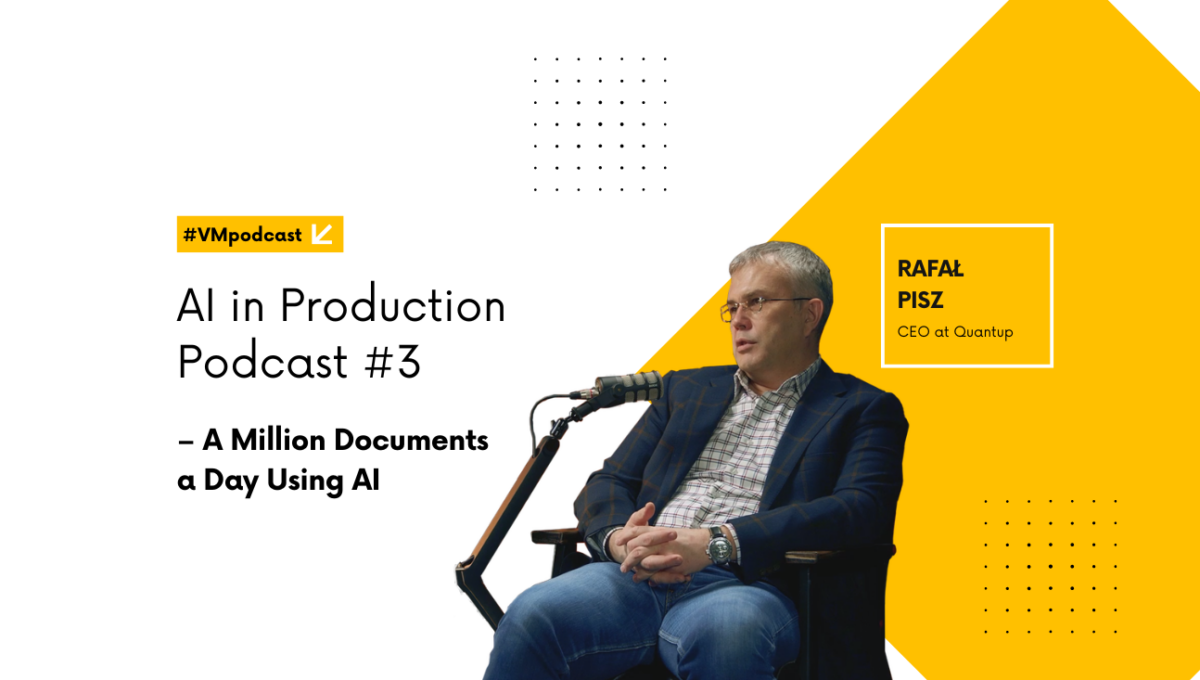
To discuss how the project worked and what role artificial intelligence played in it, we talk with Rafał Pisz, CEO of Quantup, in the podcast “AI in Production.”
Table of Contents
The problem: when 10% of documents block the entire process
At first glance, the process in the health insurance system seems straightforward.
After a medical service is provided, several documents are generated:
- a medical report from the healthcare provider,
- cost information,
- the insurer’s decision,
- a settlement statement for the patient.
These documents must be reconciled, meaning they need to be compared and verified to ensure that all the information matches.
The problem is that not all documents are digital in practice. Many organizations use EDI standards and electronic data exchange, but some participants in the process still send documents as paper copies or scanned files. Even if this represents only 5 to 10 percent of all documents, those documents become the biggest bottleneck in the entire process.
As Rafał Pisz explains:
“Even though we have highly standardized communication schemas, some participants in the process are still unable to use them and continue relying on printed documents. This becomes a limitation for the entire process.”
In practice, this means one thing: without automated document processing, the process cannot scale.
The scale of the problem: one million documents per day
The client we worked with operates in the sector of medical documentation billing services. Across the entire process, an enormous number of documents appear every day.
As mentioned in the podcast:
“We are talking about a project where, within the entire ecosystem of participants in this process, one million documents circulate every day.”
Previously, a significant portion of the work was performed by large teams of analysts who manually:
- reviewed documents,
- checked their structure,
- identified the document type,
- routed them to the appropriate process.
At this scale, however, a fundamental problem appears. If a company wants to scale the business tenfold, it does not simply mean hiring ten times more people.
In practice, the number of employees would have to grow even more due to natural constraints such as:
- limited availability of specialists,
- operational costs,
- the complexity of managing large teams,
- decreasing efficiency at scale.
For this reason, the client decided to implement an AI-based automated document processing system.
Why OCR alone is not enough
Many managers assume that the document problem can be solved with a simple approach: scan the document and apply OCR. In reality, that is only the beginning.
As Rafał Pisz explains:
“Many people say: this is simple, just scan the document, run OCR and you’re done. In reality, that is only the beginning of the problem.”
Once documents are scanned, several new challenges emerge:
- Where does a document begin and end?
A single file may contain several documents. - What type of document is it?
Is it an invoice, a medical report, or a service confirmation? - Which process should it be routed to?
- What should happen when the system is uncertain?
These were exactly the challenges that became central to the project.
How the AI solution works
The project used Document Understanding models based on transformer architecture. The models were additionally fine-tuned on the client’s data so they could better understand the specific types of documents appearing in the process.
The system performs two key tasks.
- Document segmentation
The model identifies:
- the beginning of a document
- the end of a document
- the boundaries between documents
- Document classification
After segmentation, documents are classified and routed to the appropriate business process. The system was designed so that in situations of uncertainty it requests human intervention. This ensures that automation does not introduce risk to the overall process.
90% accuracy that transforms the process
One of the key metrics in the project was the accuracy of identifying document boundaries.
As Rafał Pisz explains:
“We built a solution that recognizes the beginning and end of a document with 90 percent probability. If the system is not sure, it raises a flag and asks a human for help.”
At first glance, 90 percent accuracy may not seem perfect. In practice, however, this level of accuracy fundamentally changes how the entire process operates.
Why?
Because people stop performing repetitive tasks and instead focus only on:
- exceptions,
- complex cases,
- quality control,
- This represents a major operational shift.
ROI measured in weeks
Although the project took several months and involved a team of AI, data science and document processing specialists, the results made it possible to:
- significantly reduce operational costs,
- increase operational scale,
- accelerate document processing,
- improve process quality.
This highlights one of the most important characteristics of well-designed AI projects. When the right business problem is addressed, ROI appears very quickly.
Document AI is a challenge across many industries
Although this project focused on the U.S. health insurance market, a similar challenge exists across many sectors:
- logistics,
- manufacturing,
- banking,
- public administration,
- healthcare.
In each of these industries, the same pattern appears.
- Most processes are already digital.
- However, some documents are still paper-based.
- Just a few percent of documents can block the entire automation process.
This is exactly where Document AI technologies create the greatest value.
Will AI completely replace humans?
The podcast also raises an important question about the future.
Will document processing become 100 percent automated in the future?
Rafał Pisz offers a very pragmatic answer:
“The goal is not to pursue 100 percent automation dogmatically. What matters is solving the problem that is currently limiting the company’s growth.”
In practice, this means that the best AI projects are not about completely replacing people. Their purpose is to remove bottlenecks in business processes.
Listen to the full podcast episode
If you are interested in:
- how AI is implemented in document processing,
- the biggest challenges in AI projects,
- how to achieve ROI in machine learning initiatives.
listen to the full episode of the podcast “AI in Production” featuring Rafał Pisz from Quantup.
In the conversation, we discuss the details of the project, the technologies involved and practical insights for companies that want to use AI in their processes.
We also describe this approach in our case study, where we show how the use of AI models and OCR enabled the automation of over 80% of documents and significantly increased process scalability.