



Table of Contents
What is the podcast episode about?
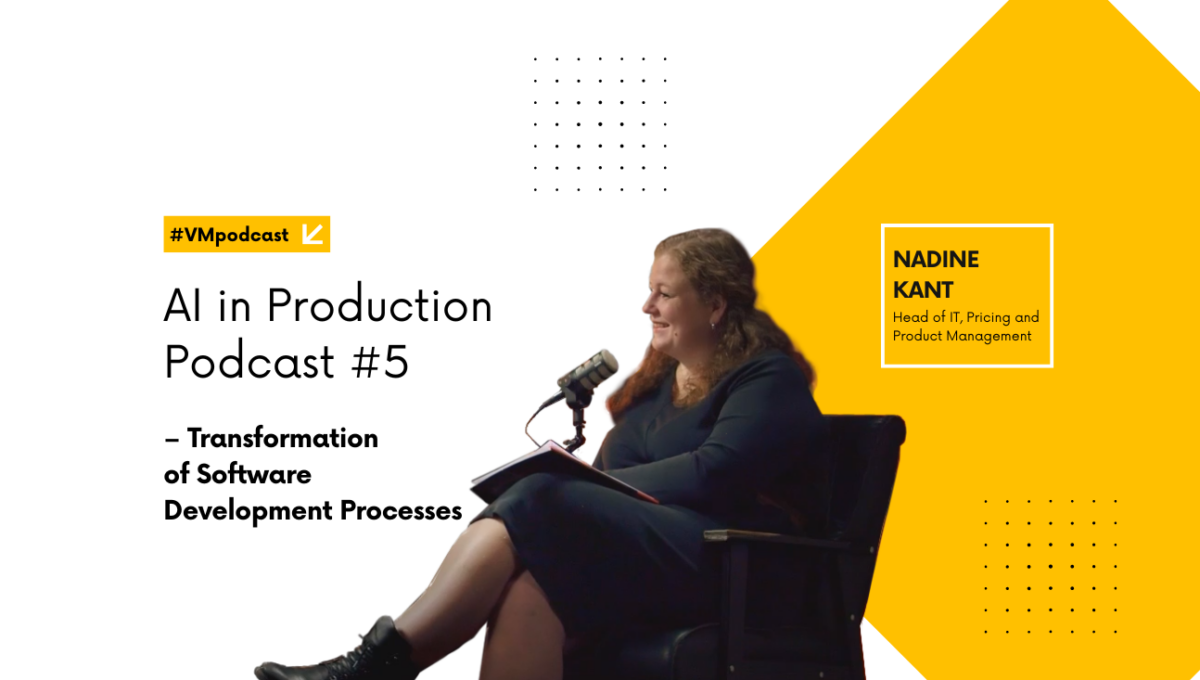
In this episode of the AI in Production podcast, we talk to Nadine Kant, IT Manager at Saxoprint, about the practical implementation of artificial intelligence in an organization. The conversation focuses on combining Agile transformation with AI tools such as GitHub Copilot and their impact on the daily work of a development team.
This is a case study based on a real project, where a change in the way of working and the introduction of new technologies led to measurable business outcomes.
Problem: lack of predictability and chaos in IT
At the beginning, the team faced challenges typical for many IT organizations. It was difficult to determine when tasks would be completed, requirements were often not fully defined before work began, and project scope changed during execution.
Additionally, there was a lack of transparency for the business. Questions arose about what IT was actually working on and what the progress was.
The result was a high Lead Time of around 90 days and growing frustration on both the team and stakeholder sides.
Agile first, then AI
One of the key takeaways from the project is that implementing AI does not make sense without a well-structured process. That is why the first step was to change the way of working by adopting an Agile approach.
The team moved to a higher level of planning by introducing a structure of Initiatives, Epics, and User Stories. Tasks were broken down into smaller, more precise elements. Preparation before the sprint was also significantly improved.
This made it possible to build a solid foundation for the later implementation of AI-based tools.
What really changed the team’s way of working
The biggest change was not related to technology, but to the way of working. Tasks became more granular and better described. Planning stopped being declarative and started to rely on real data and the team’s actual capacity.
Predictability improved, the number of revisions decreased, and collaboration with the business became more transparent.
The team gained greater control over the process, which translated into higher efficiency.
GitHub Copilot in practice
Only after the processes were structured was GitHub Copilot introduced. For the team, it became real support in everyday work.
Developers use it to generate code, optimize existing solutions, and solve problems faster. This allows them to focus on more complex areas, such as system architecture.
The role of the developer has not been replaced, but shifted toward more demanding and higher-value tasks.
Breakthrough: shorter Lead Time and better planning
The most measurable effect of the transformation was a significant reduction in Lead Time. It was reduced from around 90 days to less than 20 days.
At the same time, Cycle Time, meaning the time from the start of work to task completion, was also shortened.
Better planning, smaller tasks, and greater process transparency directly translated into faster value delivery.
Challenges in implementing AI
The implementation of AI was not without challenges. At the beginning, there was resistance within the team, driven by concerns about technology replacing people.
Educational efforts and the gradual introduction of the tool into daily work proved to be key. Over time, as the quality of AI-generated results improved, acceptance among employees also increased.
An important factor was also learning how to use the tool effectively, including the ability to formulate precise prompts.
Business results and savings
The transformation delivered tangible business outcomes. The project was completed approximately four weeks earlier than originally planned.
This resulted in savings of around €40,000 per month.
It shows that combining a well-structured process with the effective use of AI can have a direct impact on an organization’s financial performance.
What’s next: scaling the solution
After completing the Proof of Concept phase, the company plans to roll out the solution to additional teams. GitHub Copilot will be made more widely available, and the developed Agile practices will be implemented across the entire organization.
Thanks to the experience gained, future implementations should be faster and more efficient.
Listen to the podcast episode
If you are interested in the practical use of AI in organizations and the real effects of Agile transformation, it is worth checking out the full episode.
If you would like to better understand the entire transformation process and explore more details about the implementation, we have prepared a full case study on our website. There you will find a detailed description of the challenges, the course of the project, and the achieved results, including the impact on team efficiency and business outcomes.