












 AI/ML
 Software Development



Green AI in Industry: How Artificial Intelligence Reduces Costs, Emissions, and Energy Consumption
Sustainability is no longer merely a component of corporate branding strategy. For a growing number of industrial companies, it has become a tangible driver of competitiveness — influencing operational costs, supply chain resilience, and the ability to meet increasingly stringent regulatory requirements.
In this context, artificial intelligence is beginning to play a critical role — not as an abstract innovation, but as a practical tool for reducing energy consumption, raw material usage, and emissions. This is where the concept of Green AI emerges.
Green AI refers to the application of artificial intelligence to optimize energy usage and reduce CO₂ emissions in industrial processes, while simultaneously improving production efficiency. In practice, this includes intelligent machine control, predictive maintenance, and supply chain optimization. For many companies, such initiatives can translate into 10–30% energy savings, reduced downtime, and a positive return on investment within 12–24 months.
Table of Contents
What Is Green AI? AI as a Driver of Sustainable Development
Definition: How Artificial Intelligence Supports the Ecological Transition
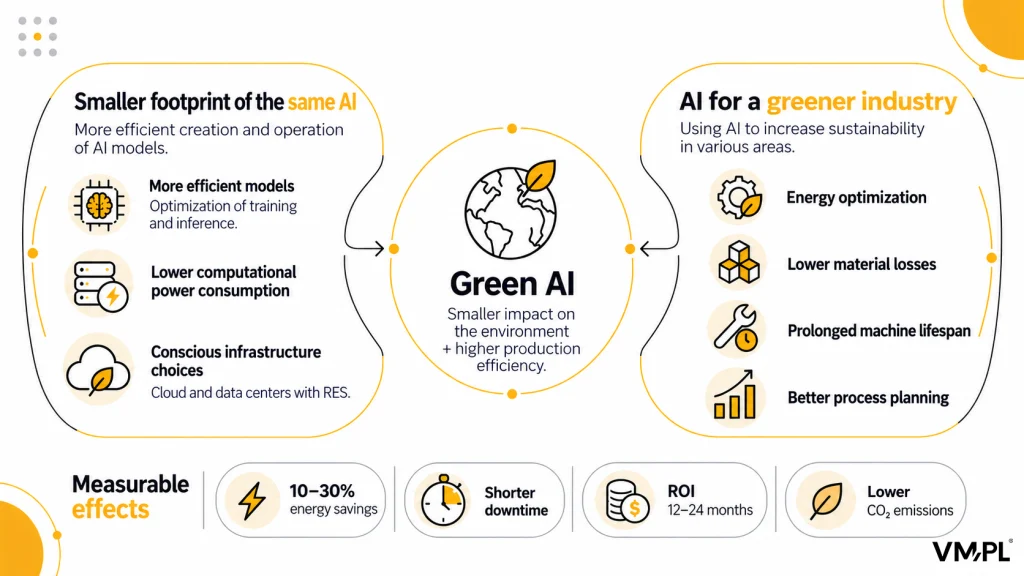
Green AI refers to an approach to designing, training, and deploying artificial intelligence systems in a way that minimizes their environmental impact while maximizing their positive ecological contribution across other business areas.
In practice, this means using algorithms to optimize energy consumption, reduce material waste, extend machine lifecycles, and improve production planning efficiency.
In industry, Green AI is not an abstract research concept. It represents a set of practical applications that enable companies to better understand factory processes, predict their behavior, and make data-driven decisions instead of relying solely on intuition. This makes it possible to achieve environmental goals without compromising efficiency or quality.
According to international organizations, AI could contribute to reducing global greenhouse gas emissions by 5–10% by 2030 — equivalent to the total emissions of the European Union — provided solutions are widely implemented and scaled across energy and industrial sectors.
In Poland and across Europe, AI is no longer experimental — in more than half of industrial companies, technologies such as IoT, cloud computing, data analytics, and AI are becoming standard practice.
Dual Focus: Reducing AI’s Own Carbon Footprint vs. Using AI to Reduce Other Emissions
When discussing Green AI, it is important to distinguish between two complementary dimensions.
The first focuses on reducing the carbon footprint of AI systems themselves — through more efficient models, lower computational requirements, and conscious infrastructure choices.
The second — far more impactful from an industrial perspective — focuses on using AI to reduce emissions and resource consumption across broader operations.
It is this second dimension that offers the greatest potential. Even if model training requires energy, the benefits from optimizing production processes, logistics, and energy management typically far outweigh those costs. The key lies in intentional system design and a clear focus on measurable business value.
AI for Energy Efficiency: Optimizing Energy Consumption and Energy Systems
Energy represents one of the largest operational cost drivers in industry. Artificial intelligence enables a holistic view of energy usage — not merely as meter readings, but as a dynamic system influenced by production schedules, environmental conditions, and machine health.
Predictive models can forecast energy demand, detect inefficient consumption patterns, and recommend real-time adjustments. This enables not only cost reduction but also better integration of renewable energy sources and reduced peak loads on energy grids.
Technical Implementation and Challenges
Data Foundation and Model Training
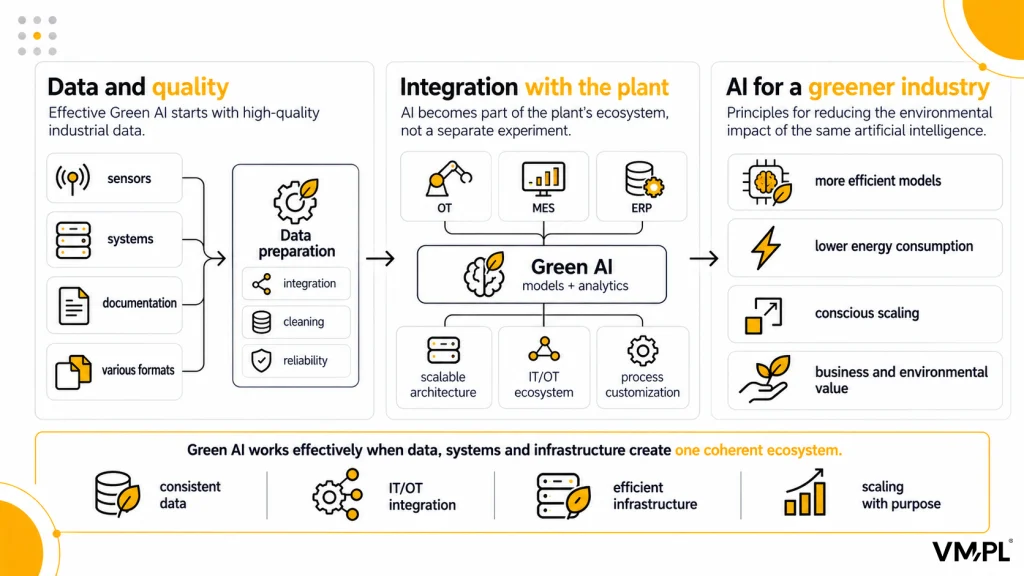
Effective Green AI solutions are built on high-quality data. Predictive models require consistent, complete, and up-to-date information — which can be challenging in industrial environments. Data often originates from multiple systems, comes in different formats, and varies in granularity.
Without proper data preparation, even the most advanced algorithm will fail to deliver expected results. Therefore, a critical implementation phase involves data cleansing, source integration, and ensuring reliability and integrity.
Integration with Existing Systems
Most industrial facilities operate on legacy infrastructure that was not originally designed with AI in mind. Integrating new solutions with existing OT, MES, or ERP systems requires experience, flexible architecture, and a deep understanding of business processes.
Green AI should not remain an isolated “technology experiment.” To deliver real value, it must become part of the IT and OT ecosystem, supporting everyday operational decision-making.
The “Green” Footprint of AI
While AI can support sustainability, it also consumes energy. Training large models and maintaining them in production environments involves environmental costs. Increasing attention is therefore being paid to algorithm efficiency, infrastructure choices, and responsible scaling strategies.
Green AI is not only about what we optimize — but also how we optimize it, with ethical and environmental considerations in mind.
Key Application Areas of Green AI in Industry
Energy Consumption Prediction and Optimization
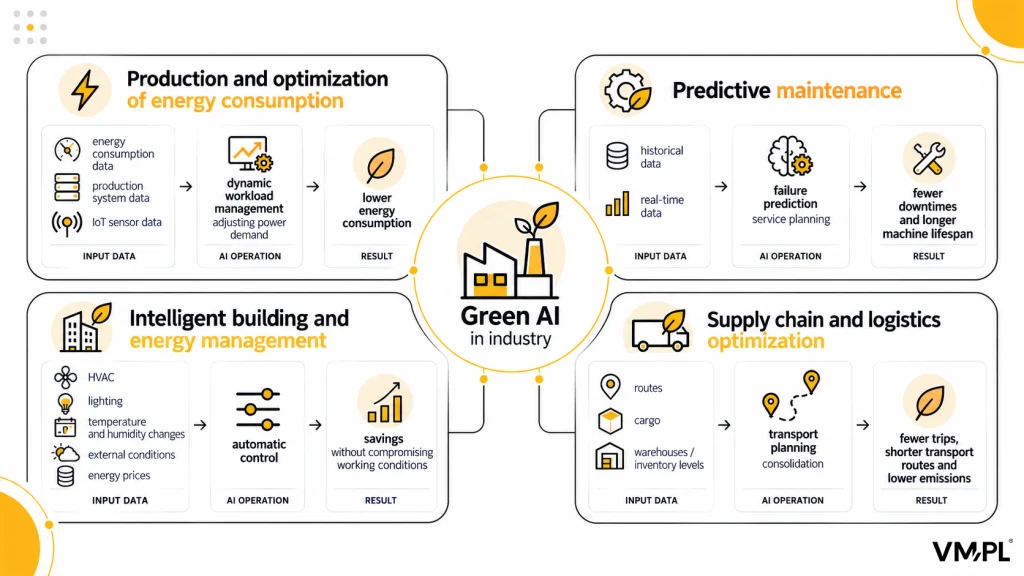
Green AI analyzes large volumes of data from production systems, energy meters, and IoT sensors in real time to automatically adjust equipment operation to current needs — reducing energy usage without compromising performance.
Such models support:
- Dynamic load management of production lines
- Reduction of energy losses by eliminating unnecessary operating cycles
- Continuous adjustment of power consumption to changing operational conditions
Predictive Maintenance: Fewer Failures, Less Waste
Traditional maintenance approaches can lead to unplanned downtime or premature replacement of components. Green AI enables failure prediction based on historical and real-time data, reducing downtime and extending machine lifecycles. For many facilities, predictive models deliver greater value than conventional service schedules.
Intelligent Building and Energy Management
AI can control HVAC systems and lighting in industrial facilities by considering workforce presence, shift schedules, external conditions, and energy prices — achieving significant energy savings without compromising working conditions.
Supply Chain and Logistics Optimization
AI optimizes transportation routes, consolidates shipments, and manages inventory levels — reducing the number of trips, shortening delivery times, and lowering logistics-related emissions.
Practical Scenarios: How Green AI Works in Companies
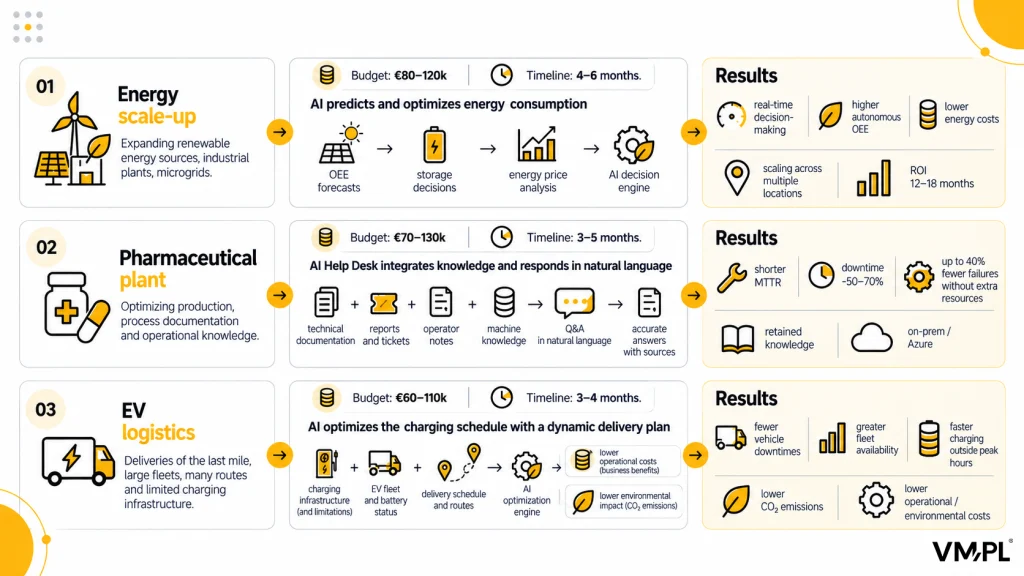
Case 1 — Scale-up: AI-Based Energy Optimization
Company: Technology firm specializing in energy management in decentralized environments (industrial parks, commercial facilities, microgrids)
Objective: Intelligent real-time optimization of energy consumption, storage, and trading using predictive models and AI algorithms
Budget: ~€80,000–€120,000
Timeline: 4–6 months
Results:
- Dynamic decision-making: when to buy energy, when to sell surplus, and when to use storage systems
- Improved self-consumption of renewable energy and reduced operational costs
- Scalable deployment across multiple locations with different energy profiles
- Better responsiveness to fluctuating energy prices and weather conditions
- ROI dependent on facility profile — typically achievable within 12–18 months through energy cost reduction and optimized battery usage
Description: The client required an intelligent system capable of real-time decision-making in decentralized environments where energy production, consumption, storage, and trading occur simultaneously.
More details on system architecture, predictive models, and achieved business outcomes are available in our full case study.
Case 2 — Manufacturing Plant: AI Help Desk for Maintenance
Company: European production facility of a large pharmaceutical company (solid dosage production — tablets and capsules)
Objective: Reduce response time to failures and centralize operational knowledge in maintenance
Budget: ~€70,000–€130,000
Timeline: 3–5 months
Results:
- Reduced MTTR (Mean Time To Repair) through instant access to knowledge
- 50–70% reduction in downtime
- Up to 40% of incidents resolved without central maintenance team involvement (Autonomous Maintenance)
- Standardization and retention of operational knowledge
- Secure AI deployment in production environment (on-premise / Azure)
Description: The plant faced a common issue in large industrial organizations: knowledge was fragmented across machine manuals, ticketing systems, technical notes, and employee experience across shifts. During breakdowns, time was critical, yet information access was slow and unstructured.
The goal was to build an intelligent system integrating all knowledge sources and enabling natural language queries without requiring users to understand file structures or IT systems.
The solution was OEE Booster — a dedicated AI Help Desk built on Retrieval-Augmented Generation (RAG) architecture and Large Language Models (LLMs).
Further details on architecture, implementation process, and KPIs are available in the full case study.
Case 3 — Logistics Company: AI Optimization of EV Fleet Charging
Company: Last-mile logistics operator in a major city (dozens of EVs, hundreds of daily orders)
Objective: Dynamic optimization of EV fleet charging under limited infrastructure and high operational variability
Budget: ~€60,000–€110,000
Timeline: 3–4 months
Results:
- Reduced vehicle downtime caused by inefficient charging schedules
- Increased fleet availability and higher order fulfillment capacity
- Lower energy costs through intelligent off-peak charging
- Reduced CO₂ emissions through optimized charging windows and energy source selection
- Flexible switching between cost-optimization and environmental-optimization modes
Description: With fleet electrification, the client faced limited charging infrastructure, fluctuating delivery schedules, and operational disruptions. Traditional planning was no longer sufficient.
We developed a solution based on two pillars:
- A DSL (Domain-Specific Language) for flexible modeling of infrastructure constraints
- An AI optimization engine generating real-time charging plans based on cost or CO₂ objectives and dynamically adapting to changes
More information on system architecture, optimization algorithms, and performance metrics is available in our full case study.
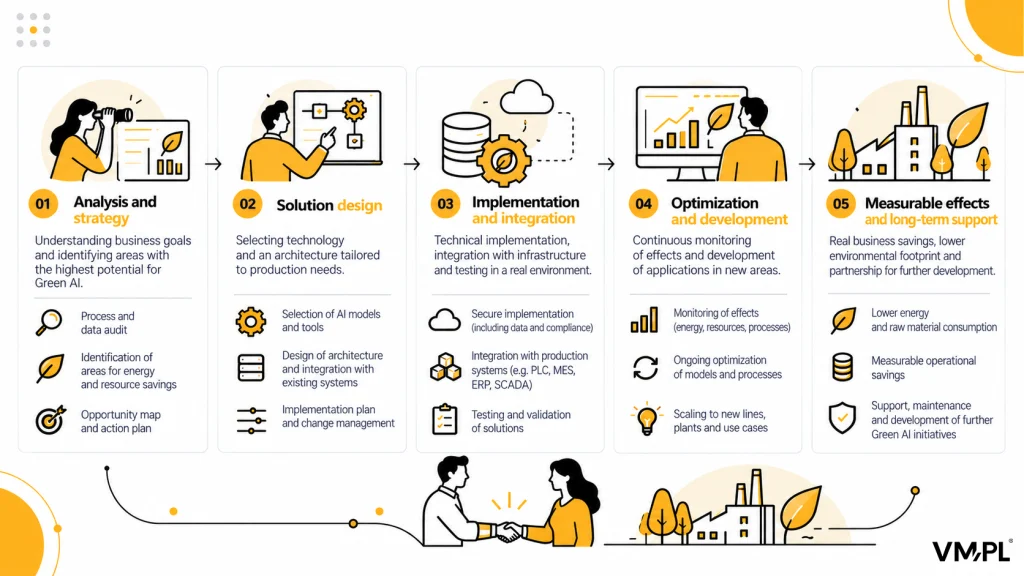
Your Green AI Partner: From Strategy to Implementation
Analysis and Advisory
Successful Green AI implementation begins with a deep understanding of processes and the identification of real savings potential. Data analysis, energy audits, and jointly defined objectives help focus on areas where AI will generate the greatest value — both business and environmental.
Developing Dedicated AI Solutions
Every organization is different, which is why off-the-shelf solutions rarely address all needs. Dedicated AI models, designed around specific processes and sustainability goals, enable long-term impact and measurable results.
A long-term approach is essential — continuous model improvement, performance monitoring, and solution evolution aligned with organizational growth.
Green AI in industry is not a one-time project, but a strategic path toward more efficient, resilient, and sustainable production. Companies that choose this path today will be not only more environmentally responsible tomorrow, but also more competitive.
If you are looking to combine cost optimization, emission reduction, and tangible technological advantage, let’s discuss how Green AI can support your business — from strategy and implementation to long-term solution development.
Categories:


Design, Development, DevOps or Cloud – which team do you need to speed up work on your projects? Chat with your consultation partners to see if we are a good match.
Jakub Orczyk
Member of the Management Board/ Sales Director VM.PL
Book a free consultation